Step 2 of 10: Organisation & Planning

ORGANISATION & PLANNING
ORGANISATION & PLANNING
FROM IDEAS TO A WORKING SYSTEM
Step 2 turns your lubrication strategy into a database, a schedule, an owner for every task, and a number that tells you whether it's actually happening. No plan survives contact with the plant floor unless it's built to be checked.PRIMARY RISK
Schedules that rely on memory,
not a system
GOVERNS
Asset registration, scheduling,
KPIs
FEEDS INTO
Step 3: Identification &
Inspection
A lubrication strategy is only as strong as its execution. Once your current state is assessed
(Step 1), the next crucial step is Organisation and Planning, where ideas become actions, and actions become habits.
At Lubretec, we understand that even the best-intentioned maintenance teams can fall short without a structured approach. That's why this step focuses on transforming your lubrication strategy into a practical, repeatable, and trackable system that works across teams, shifts, and equipment types.
WHERE MOST PROGRAMMES STAND
WHAT DOES GOOD ORGANISATION LOOK LIKE?
Good organisation isn't about doing more; it's about doing the same things, the same way, every time:
- Every lubrication point is known and documented
- Lubrication tasks are scheduled, not left to memory
- The right person performs the right task at the right time
- Lubrication information is easy to access and update
- Progress and compliance are tracked and reported.
In place
- Every lubrication point is known and documented - not tribal knowledge held by one senior technician.
- Tasks are scheduled, not left to memory or a laminated sheet from 2014.
- Ownership is assigned - a named person, not "maintenance" in general.
- Lubrication data is accessible and kept current as assets change.
- Compliance is tracked and reviewed, not just recorded and filed.
Usually missing
- Criticality tiering - every point treated the same, regardless of failure consequence.
- Named KPIs with targets - "we track compliance" without a number attached to it.
- Time-based vs. condition-based logic - schedules that never adapt to actual oil condition.
- Technician competency verification - the right person assigned, but not confirmed as trained.
- Route design - points scheduled individually rather than walked as an efficient sequence.
THE FIVE PILLARS
WHAT EFFECTIVE LUBRICATION PLANNING IS BUILT FROM.
Each pillar answers one operational question. Skip one, and the others start to erode — a schedule without an owner drifts; an owner without a checklist improvises.

ASSET-BASED LUBRICATION DATABASE
Build a centralised list of machines, each with clearly identified lubrication points, lubricant types, quantities, and intervals. Every detail matters — asset ID, point location, lubricant grade, fill quantity, base interval, and access method should all be captured.

SCHEDULING & FREQUENCY MANAGEMENT
Develop time-based or condition-based schedules using your CMMS or a dedicated planning tool. Time-based intervals are the right default; move an asset to condition-based triggers (oil analysis results, particle counts, viscosity drift) once you have reliable monitoring data for it. Ensure coverage of all assets with defined lubrication routes, grouped by location rather than scheduled point-by-point.

ROLES & RESPONSIBILITIES
Assign lubrication duties clearly across your team. Define who is responsible, accountable, and who provides support or verification — and confirm the assigned person is actually trained for the task, not just available for it.

WORKFLOWS & CHECKLISTS
Standardise lubrication tasks with clear work instructions. Avoid shortcuts by using checklists, visual aids, or mobile-friendly SOPs (Standard Operating Procedures).

MONITORING & FEEDBACK LOOPS
Integrate lubrication KPIs into your reporting. Know what's done, what's missed, and why. A few to start with: scheduled task compliance (target ≥95% on critical assets), missed lubrication points per month (target under 3%), and consumption variance versus baseline (±10% flags over- or under-lubrication). Use this feedback to continuously refine your planning.
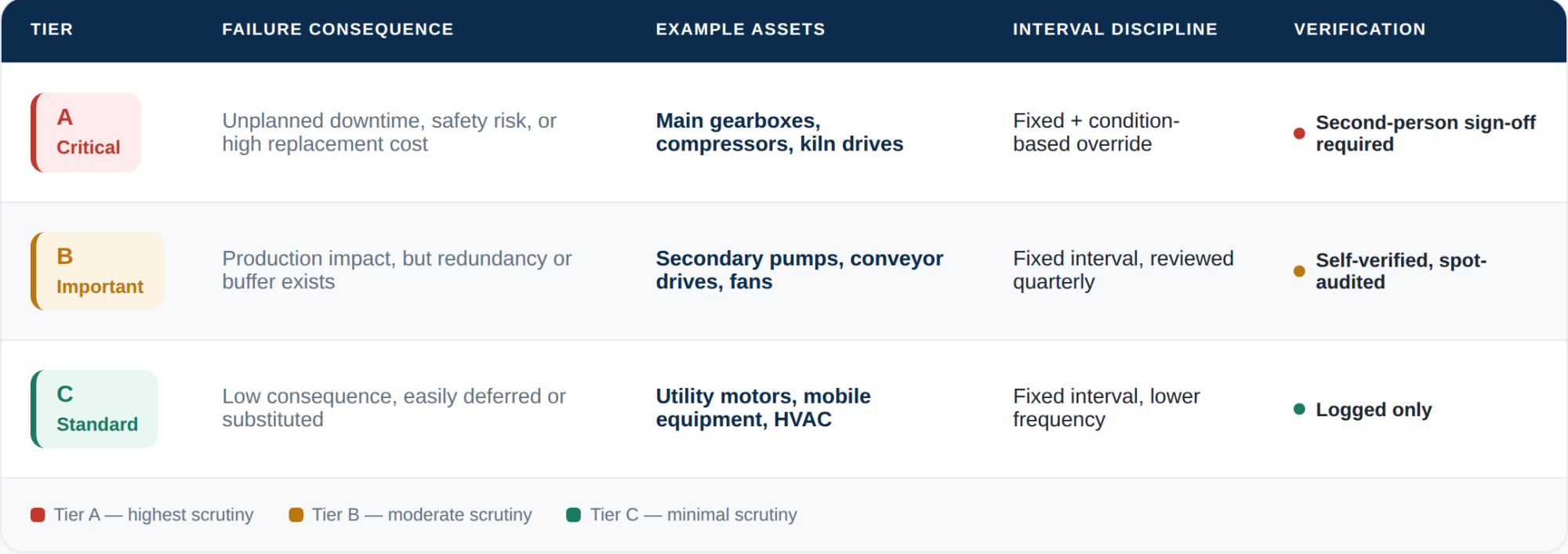
CRITICALITY TIERING
NOT EVERY LUBRICATION POINT DESERVES THE SAME ATTENTION.
Planning effort should follow failure consequence, not treat every asset the same. Before scheduling, rank your assets:
Tier A - Critical Failure consequence: unplanned downtime, safety risk, or high replacement cost Examples: main gearboxes, compressors, kiln drives Interval discipline: fixed interval with condition-based override Verification: second-person sign-off required
Tier B - Important Failure consequence: production impact, but redundancy or buffer exists Examples: secondary pumps, conveyor drives, fans Interval discipline: fixed interval, reviewed quarterly Verification: self-verified, spot-audited
Tier C - Standard Failure consequence: low consequence, easily deferred or substituted Examples: utility motors, mobile equipment, HVAC Interval discipline: fixed interval, lower frequency Verification: logged only
SCHEDULING LOGIC EXPLAINED
TIME-BASED AND CONDITION-BASED AREN'T INTERCHANGEABLE
Both are legitimate. The mistake is using the term "condition-based" without a defined trigger behind it.
Default baseline
Time-based
Lubrication happens on a fixed calendar or run-hour interval, set from OEM guidance and adjusted by operating experience.
Use when: no reliable condition data exists yet, for lower-tier assets, or as the fallback interval underneath a condition-based programme.
Trigger: calendar date or run-hour count.
Higher precision
Condition-based
Lubrication is triggered by measured evidence - oil analysis results, particle counts, viscosity drift, or vibration/temperature signatures -rather than the clock.
Use when: Tier A/B assets have consistent oil analysis or condition-monitoring coverage in place.
Trigger example: ISO cleanliness code exceeds target, or viscosity shifts >10% from baseline.
MONITORING MADE MEASURABLE
FEEDBACK LOOPS NEED A NUMBER TO LOOP BACK TO.
These four are enough to run a programme review. Start here before adding more.
≥ 95%
Scheduled task compliance
Target for Tier A assets
0-3%
0-3%
Missed lubrication points/month
Reviewed at monthly PM meeting
± 10%
Consumption variance vs. baseline
Flags over- or under-lubrication
100%
Route completion, critical assets
No partial routes on Tier A
ROUTE DESIGN
A SCHEDULE IS NOT A ROUTE.
Individually scheduled points create wasted walking time and missed stops. Group points geographically and by interval so a technician completes a full, ordered loop — the sequence below is illustrative of the logic, not a literal plant layout.
ROUTE R-04 · SOUTH HALL · EST. 38 MIN
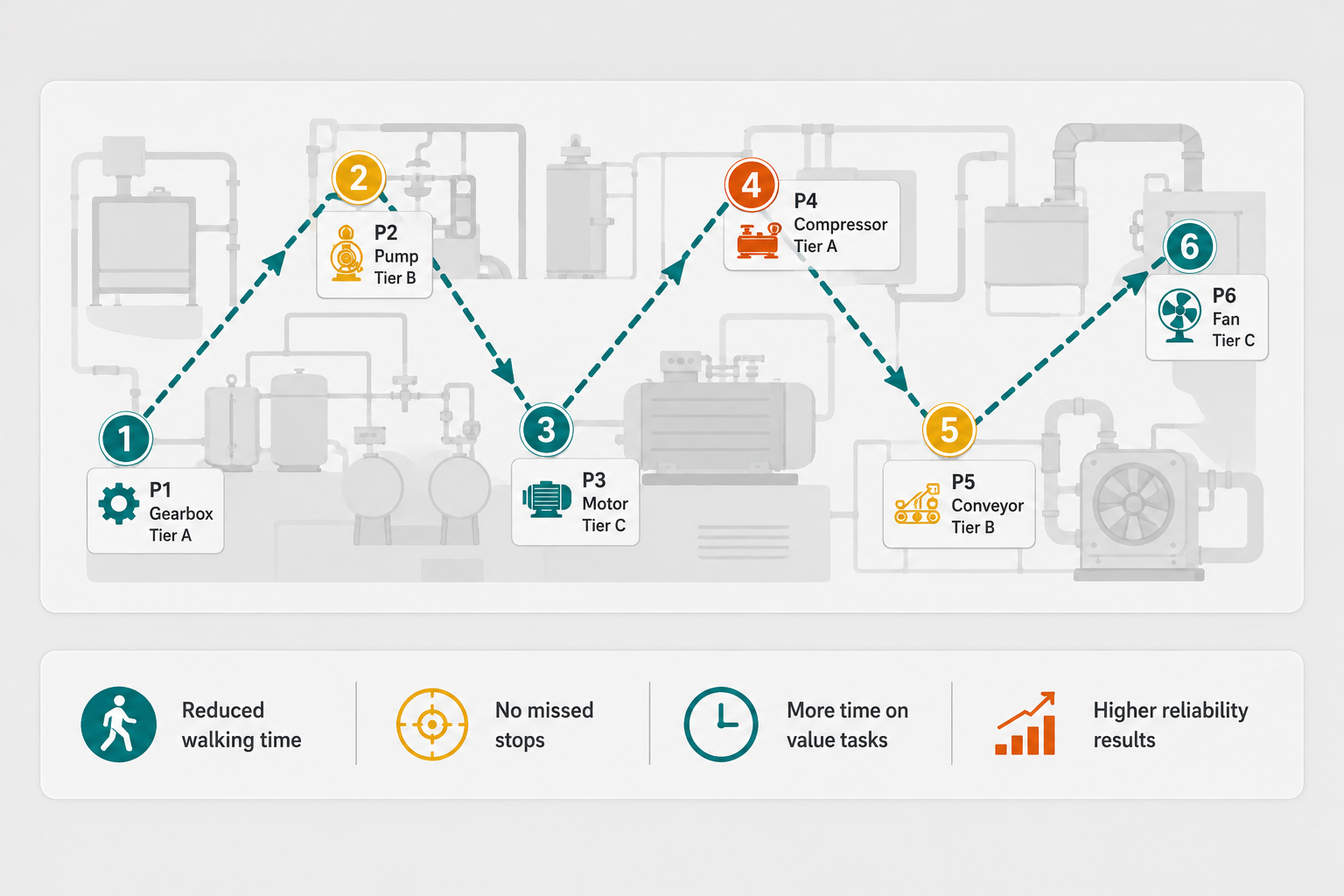
Points ordered by physical proximity, not asset list order — a single walked loop replaces six separate work orders.
SELF-CHECK
LUBRICATION PLANNING ITEMS
Use this quick self-check to gauge your current level of organisation and planning.
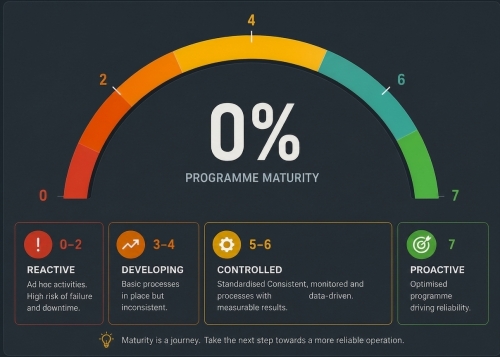
Tick the ones that are true today:
☐ Every lubrication point is documented, not memorised
☐ Tasks are scheduled in a CMMS or planner, not tracked by memory
☐ A named person — not a department — owns each task
☐ Assets are ranked by criticality before scheduling
☐ Lubrication routes are grouped into ordered, walkable loops
☐ Technicians are confirmed trained, not just assigned
☐ At least one KPI is tracked with a defined target
Score yourself:
- 0–2 ticked → Reactive. Lubrication happens, but mostly by memory and habit.
- 3–4 ticked → Developing. The basics exist but aren't consistently followed.
- 5–6 ticked → Controlled. A real system is in place and mostly holding.
- 7 ticked → Proactive. Your programme is planned, tracked, and continuously improved.
TRAINING & COMPETENCY
ASSIGNING THE TASK ISN'T THE SAME AS VERIFYING THE SKILL.
Roles & Responsibilities names who's accountable. This closes the gap between named and capable.
TASK-TRAINED
LEVEL 1
Shown the SOP and observed performing it once. Sufficient for Tier C assets and routine top-ups.
SIGNED OFF
LEVEL 2
Independently demonstrated the full task to a supervisor, including contamination-control steps. Required for Tier B assets.
CERTIFIED
LEVEL 3
Holds a recognised lubrication credential (e.g. ICML) or internal-equivalent. Required for Tier A assets and any condition-based decision-making.
WHERE PLANNING CONNECTS TO EXECUTION
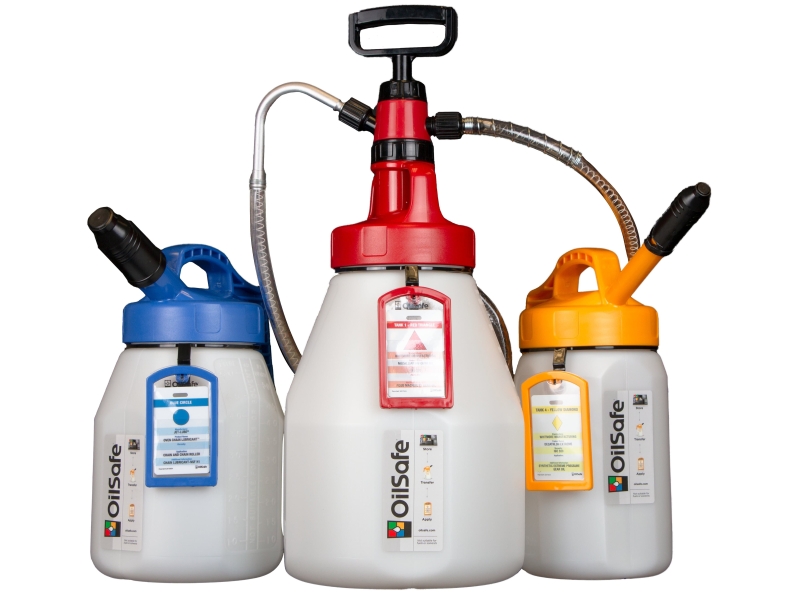
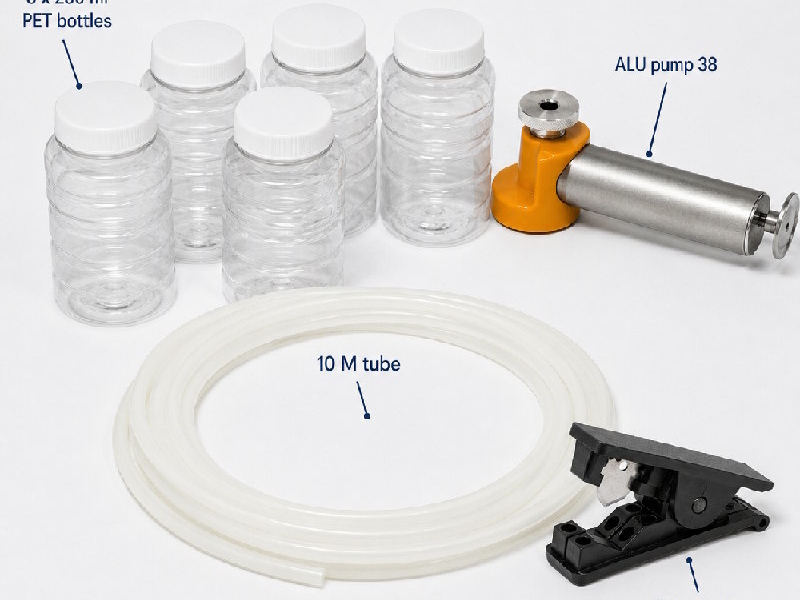
PLANNING ONLY PAYS OFF WITH THE RIGHT TOOLS ON THE FLOOR.
IDENTIFICATION
STORAGE AND DISPENSING
CONDITION MONITORING

SELF-ASSESSMENT
IS YOUR LUBRICATION PROGRAMME ACTUALLY ORGANISED, OR
INFORMALLY MANAGED?
- All assets and lube points are registered in a database or CMMS.
- Each lube point has documented lubricant type, quantity, and frequency.
- Lubrication schedules are created and regularly maintained.
- Work orders or route sheets are used to guide technicians.
- Lubrication duties are assigned to specific roles or individuals.
- Lubrication tasks are logged and tracked (digitally or on paper).
- Reports or dashboards show task completion and overdue work.
- Team members have access to current lubrication procedures and diagrams.
- Changes (e.g. new equipment or products) are updated in the system promptly.
- KPIs for lubrication (e.g. task completion, re-lube frequency) are monitored.
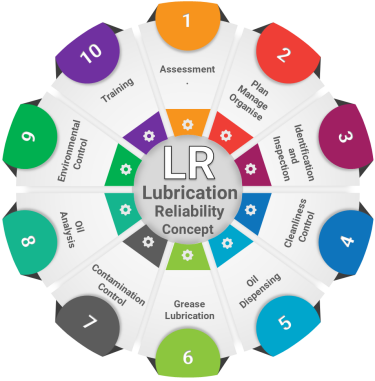
HOW THIS FITS INTO LUBRICATION RELIABILITY™
① Assess & Benchmark
2Organise & Plan
③ Identify & Inspect
④ Cleanliness Control
⑤ Dispense Precisely
⑥ Grease Effectively
⑦ Control Contamination
⑧ Condition Monitoring
⑨ Environmental Control
⑩ Knowledge Management
Step 1 tells you where you stand.
Step 2 is the system that turns that baseline into a running programme - the right lube, at the right point, at the right time. Get it right, and
Step 3's inspection routes have a real
schedule and a real owner to plug into.
PLAN TO SUCCEED, THEN PROVE IT.
Organisation and planning aren't optional; they're the core of sustainable Lubrication Reliability. When your lubrication tasks are fully integrated into your maintenance planning, you move from reactive to proactive, and from inconsistent to controlled.