Step 3 of 10: Identification & Inspection
IDENTIFICATION & INSPECTION
A lubrication point that isn't clearly identified is a point that will eventually receive the wrong product. A reservoir with no visible oil level is a failure waiting for a reason. Step 3 closes both gaps - and, critically, closes the loop when an inspection finds a problem.
PRIMARY RISK
Wrong lubricant, wrong point, undetected
GOVERNS
PLIS labelling, colour coding, inspection routes
FEEDS INTO
Step 4
(Cleanliness Control)
WHY IT MATTERS
THE FAILURE MODE IS QUIET, NOT DRAMATIC
Incorrect lubrication rarely announces itself. A technician tops up a gearbox with the nearest drum because the correct one wasn't obvious. A grease gun is reloaded with the wrong cartridge because the colour code was never applied at that point. Weeks later, a bearing fails - and the root cause traces back to a five-second decision made without the information to make it correctly.
Regular, structured inspection catches the second half of the problem: machines quietly running low, sight glasses fogged or blocked, and level indicators that were never fitted in the first place. Identification and inspection are two halves of the same discipline - one prevents the wrong lubricant going in, the other confirms the right amount is still there.
BUILDING THE SYSTEM
FIVE LAYERS OF IDENTIFICATION
Each layer builds on the one before it. Skipping straight to digital integration without the physical layer in place is the most common reason lubrication ID systems fail to stick.

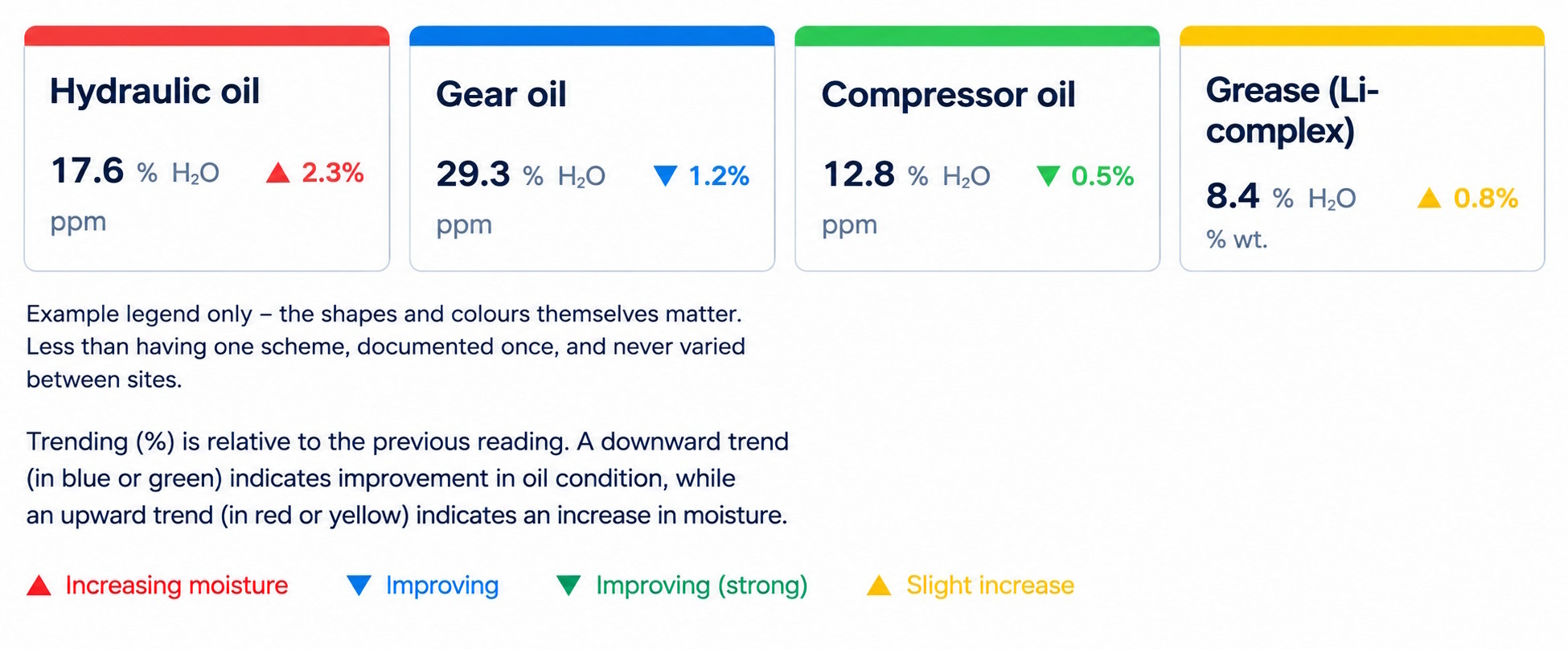
Colour & shape coding
Assign a colour and a shape to each lubricant family, not colour alone — shape coding protects colour-blind technicians and remains legible under poor lighting or on faded tags. Base the scheme on a recognised colour-and-shape identification system rather than inventing one in-house, and apply it consistently across dispensers, storage drums, transfer containers and the application point itself, so the container and the machine are always checked against each other before a drop of oil moves.

Labelling & codification
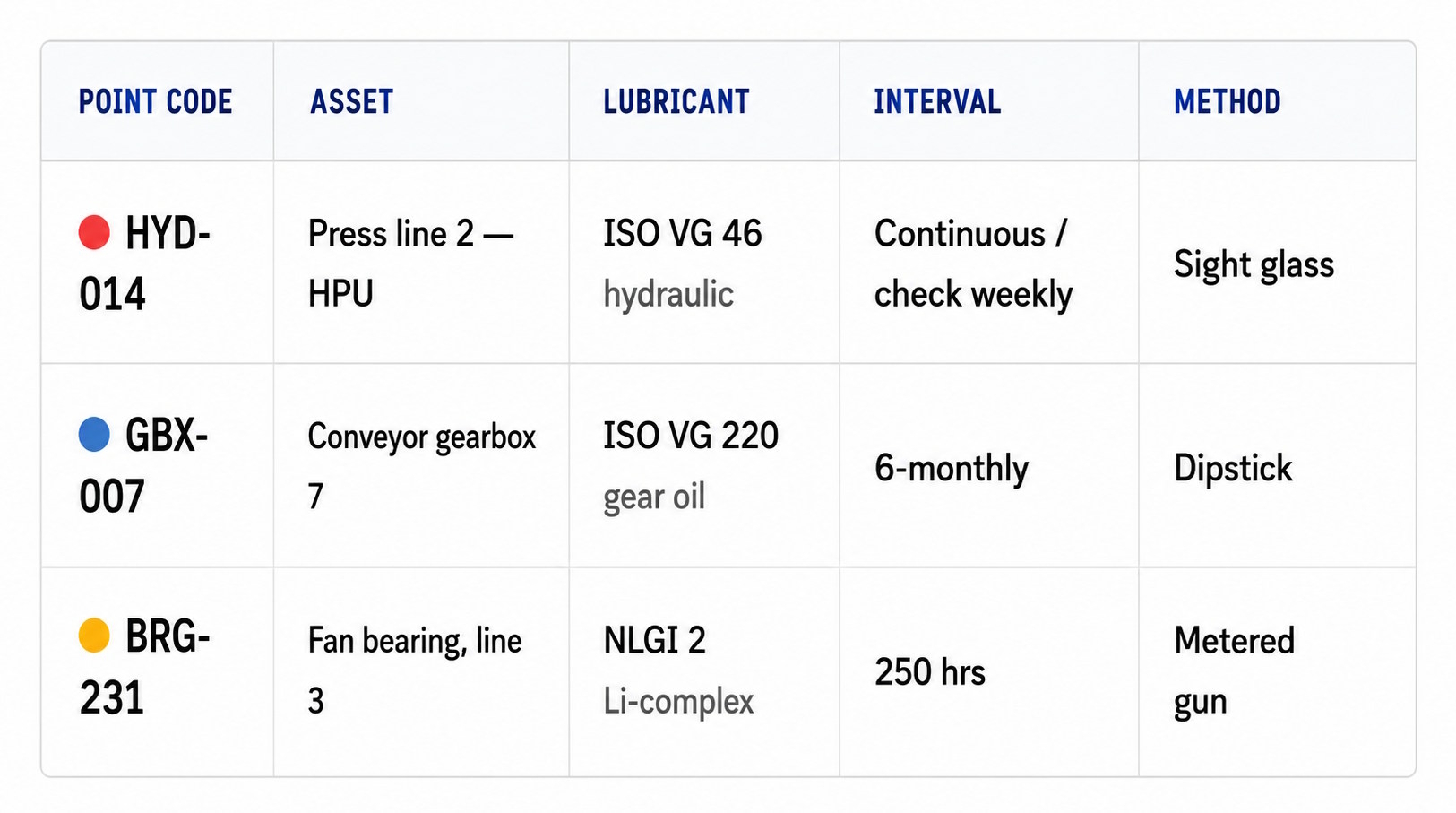
Durable, standardised tags at every lubrication point — not just the ones that are easy to reach. Each tag should carry four things at minimum: lubricant type, quantity per application, re-lubrication interval, and a unique point code that ties back to the lube chart and the CMMS asset record. Laminated or engraved tags outlast printed stickers in washdown or high-temperature areas.

Lube charts
A single, centralised chart cross-referencing every machine, its lubrication points, the correct product, and the interval — the master document everything else is checked against.

Digital integration
Linking the physical system to a CMMS or ERP platform (SAP PM, Maximo, or equivalent) is only useful if it's clear what is being tracked. In practice this means three linked records: the asset ID matched to its lubrication points, the lubricant SKU matched to its colour/shape code, and a time-stamped completion log for every application and every inspection. That third record is what turns identification from a labelling exercise into an audit trail — it shows not just what should happen, but what did.

Compliance
Align the system with the standards that actually govern it, rather than a generic reference. The relevant frameworks are asset-management and contamination-control standards, workplace safety regulation, and, only where food-grade lubricants are in use, food-contact standards specifically.
ISO 55000 / 55001
Asset management framework — the umbrella standard a lubrication ID system should sit under.
ISO 4406
Particulate contamination coding for hydraulic fluids — sets the cleanliness targets inspection is checking against
ISO 21469
Hygiene requirements for lubricants with incidental food contact — only applies where food-grade product is genuinely in use.
OSHA / local WHS
Workplace labelling and hazard-communication requirements for stored chemicals and lubricants.
TPM
Total Productive Maintenance — the operating model that gives operators ownership of daily identification checks.
CROSS-CONTAMINATION
PREVENTING INCOMPATIBLE LUBRICANTS FROM MEETING
Even trace contamination between incompatible base oils or additive packages can break down a thickener structure or trigger sludging. Prevention is procedural, not just physical.
Run a real compatibility check
- Confirm base oil compatibility first - mineral, PAO, ester and silicone bases don't all mix safely.
- Check additive packages for known clashes, particularly between EP greases of different thickener types (lithium-complex vs. polyurea vs. calcium sulfonate).
- Where in doubt, request a miscibility reference from the lubricant supplier rather than assuming compatibility from the product name alone.
- Log the result against both products in the lube chart so the check isn't repeated / or skipped next time.
Control the physical handling
- Consolidate lubricant types wherever the equipment specification allows it - fewer products in circulation means fewer chances to cross them.
- Store and dispense each product in a clearly separated, colour-matched zone.
- Dedicate transfer equipment (funnels, guns, containers) to a single lubricant family - never share a funnel across products.
- Train staff on the identification protocol itself, not just the products - most cross-contamination is a process failure, not a knowledge gap.
INSPECTION
MORE THAN A QUICK GLANCE
Identification alone isn't enough. Machines are routinely found running with insufficient lubricant - not through neglect, but because a leak went unnoticed, a sight glass was blocked, or no level indicator existed to check in the first place.
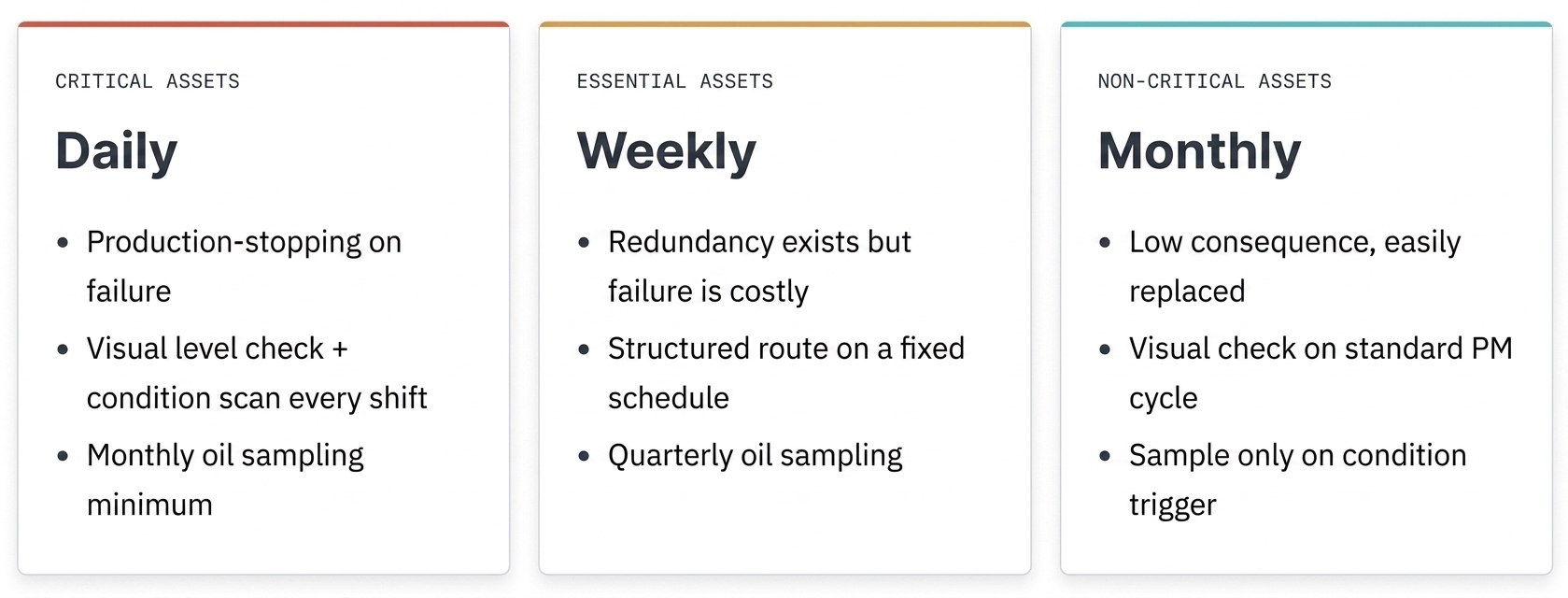
Set inspection frequency by criticality, not by habit
A fixed "daily walk-around for everything" approach either wastes time on low-risk assets or under-inspects the ones that matter. Tier inspection frequency to consequence of failure instead:
What a good inspection route includes
- Visual oil level indicators fitted to every critical machine: sight glasses, columnar gauges, or digital level sensors
- A fixed walking route with a defined order, so no point is habitually skipped
- Visual oil analysis at each stop; colour, clarity, and the presence of water or particulate
- Sampling points for deeper diagnostic testing where a visual check flags a concern
Finding leaks before they're obvious
- Thermal imaging : spots the temperature differential a slow seep creates around a seal
- Dye tracing : fluorescent additive under UV light, useful on intermittent or low-volume leaks
- Ultrasonic detection : picks up the acoustic signature of a pressurised leak long before it's visible
- Fit external level indicators, sampling valves or transparent reservoirs to any machine currently offering no visual access at all
CLOSING THE LOOP
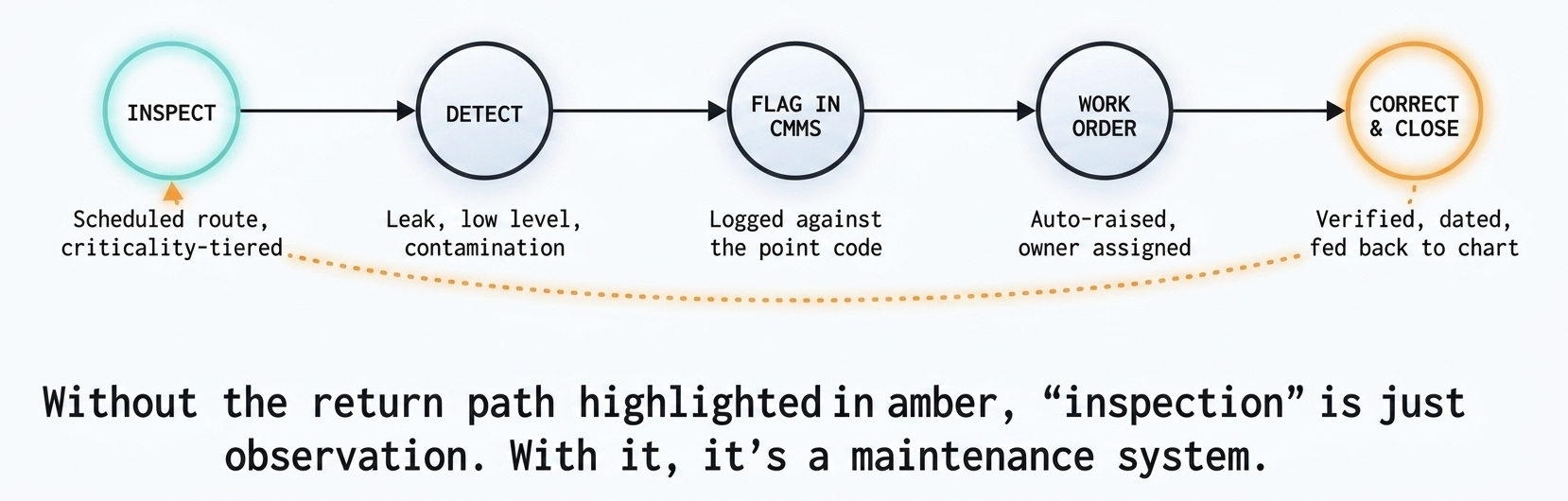
AN INSPECTION IS ONLY USEFUL IF SOMETHING HAPPENS NEXT
The most common gap in an otherwise well-run programme: inspections are completed, findings are noted on a clipboard or a form — and nothing structured happens afterwards. Step 3 isn't finished until a flagged finding automatically becomes a tracked action.
ACCOUNTABILITY
SOMEONE HAS TO OWN THE ROUTE
Programmes that stick have a named owner for every inspection point. Programmes that fade usually have a policy document and no one person accountable for walking the route this week.
Operator-driven (TPM model)
Machine operators take ownership of daily visual checks on their own equipment as part of autonomous maintenance. Works well for high-frequency, low-complexity checks — level, colour, obvious leaks — because the operator is already at the machine every shift. Requires basic training and a very simple pass/fail check sheet.
Dedicated lubrication technician
A trained specialist runs the full route across multiple assets, including sampling, chart maintenance, and CMMS logging. Better suited to critical assets, deeper diagnostics, and sites where consistency matters more than frequency. Most mature programmes run both models together — operators for daily visual checks, a technician for the structured weekly or monthly route.
MEASURING IT
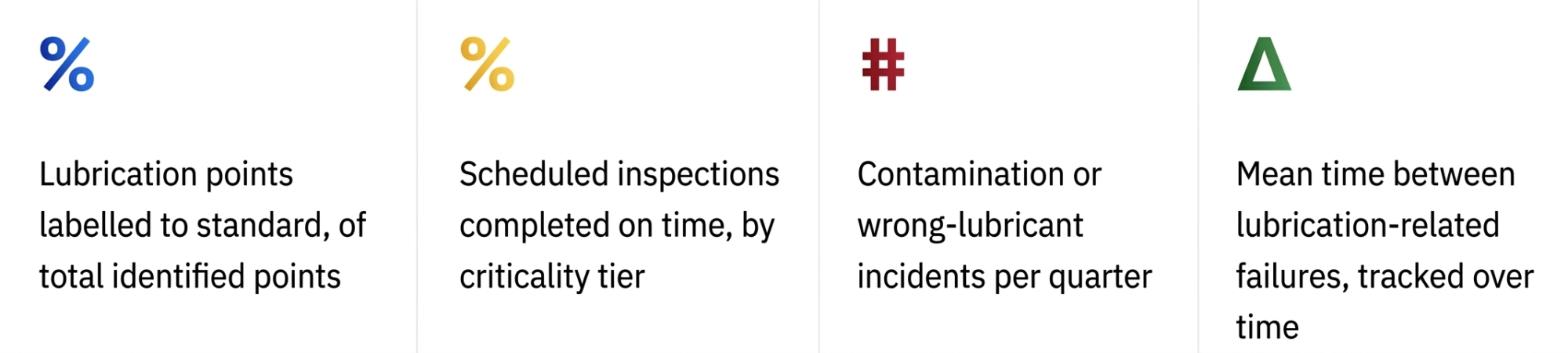
MAKE "PROACTIVE" A MEASURED CLAIM, NOT A SLOGAN
Track a small set of numbers so the programme's health is visible before a failure makes it visible instead.
SELF-ASSESSMENT
CAN EVERY LUBE POINT BE IDENTIFIED AND INSPECTED WITHOUT GUESSWORK?
- Does every lube point carry a Plant Lubrication Identification Standard (PLIS) label?
- Is a consistent colour-coding system used across containers, dispensing tools and fill points?
- Are defined inspection routes walked on a set schedule, not on an ad hoc basis?
- Are oil level indicators fitted so levels can be checked without opening the machine?
- Are inspection findings logged against the asset, not just noted informally?
- Is a new or temporary technician able to identify the correct lubricant without asking a colleague?
- Are mismatches between labelled and actual lubricant investigated when found?
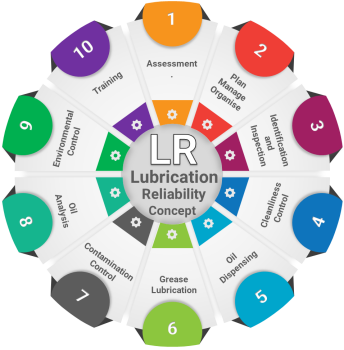
HOW THIS FITS INTO LUBRICATION RELIABILITY™
① Assess & Benchmark
② Organise & Plan
3Identify & Inspect
④ Cleanliness Control
⑤ Dispense Precisely
⑥ Grease Effectively
⑦ Control Contamination
⑧ Condition Monitoring
⑨ Environmental Control
⑩ Knowledge Management
Step 2 sets the schedule.
Step 3 makes sure that schedule can actually be followed - every point labelled, every route walked, every finding logged. Get it right, and
Step 4's cleanliness targets are being checked against real, identifiable points instead of guesswork.
The right lubricant, at the right point, at the right time - verified, not assumed.
That's the actual test of Step 3: not whether the system exists on paper, but whether a finding from this morning's inspection is already an assigned work order by this afternoon.