Step 4 of 10: Cleanliness Control
CLEANLINESS CONTROL
CLEANLINESS CONTROL
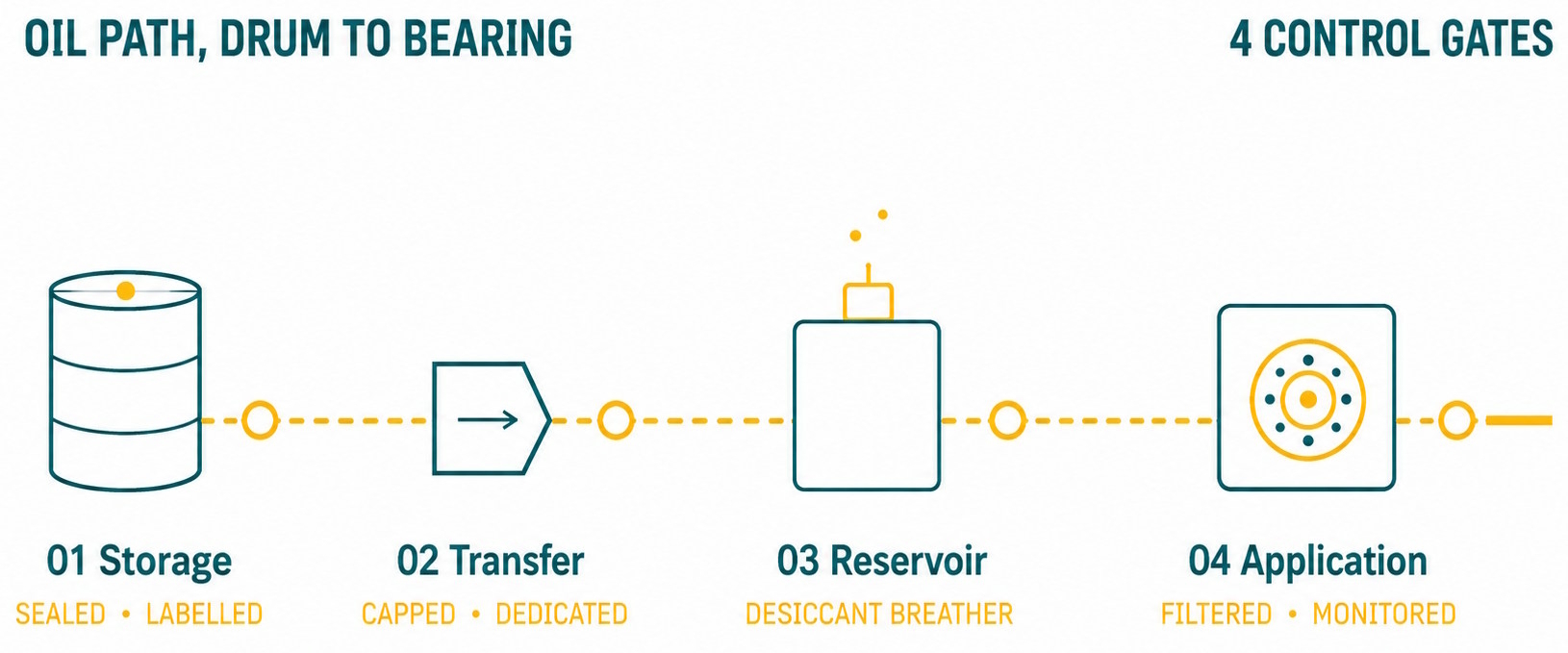
Contamination is the single most common cause of premature equipment failure, and most of it enters the system before the lubricant ever reaches the machine. Step 4 controls cleanliness across three checkpoints: storage, transfer, and application.
PRIMARY RISK
Particles and moistures ingress
GOVERNS
Storage, transfer, filtration
FEEDS INTO
Step 5 - (Dispensing) and ISO 4406 targets
WHY IT MATTERS
"OUR OIL LOOKS CLEAN" ISN'T EVIDENCE
Even tiny particles - dust, water, metal shavings, degraded oil - compromise lubricant performance and accelerate wear long before anything is visible to the eye. Once contaminants enter the system they're difficult to remove and expensive to fix. In many plants, failures blamed on "old machinery" are actually contamination failures wearing an old machine's face.
Step 3 gave you the labels, charts and inspection routes to know what's happening at each point. Step 4 is what those inspections are checking against; the cleanliness standard the lubricant should actually meet at every stage between the drum and the bearing.
"Contaminated oil doesn't just reduce performance - it silently shortens machine life with every cycle."
WHY CLEANLINESS COMES BEFORE EVERYTHING ELSE
MOST "OLD MACHINERY"FAILURES ARE DIRTY-OIL FAILURES
Contamination is one of the most common causes of premature equipment failure. Dust, water, metal shavings and degraded oil don't need to be visible to do damage — the particles that cut bearing surfaces and score gear teeth are almost always smaller than the eye can resolve.
Once contaminants are inside a system they are difficult to remove and expensive to fix. Keeping lubricant clean from the moment it leaves the refinery to the moment it enters a bearing is one of the simplest, cheapest reliability interventions available — but it only works if every handover in the chain is treated as a control point, not just the obviously dirty ones.
"Our oil looks clean. Why filter it?"
Visual clarity tells you almost nothing. The particles that cause the most wear — in the 4 to 14 micron range — are invisible to the naked eye, and even new oil from a sealed drum can carry contamination picked up in transport or storage. Filtration isn't a response to dirty oil; it's a precondition for using any oil at all.
THE THREE CONTROL POINTS
FROM STORAGE TO APPLICATION, NOTHING IS CLEANER THAN ITS WORST HANDLING STEP
Each checkpoint below is where contamination is either kept out or let in. Skipping one undoes the discipline built into the others.

01 = Storage | Keep it sealed and organised
01 = Storage | Keep it sealed and organised
Use closed, weatherproof storage units for oils and greases. Containers should be clearly labelled and colour-coded to prevent mix-ups, and protected from humidity, temperature swings and airborne contaminants. Inspect and clean storage areas on a regular schedule, not only when something looks wrong.

02 = Transfer | Keep it clean, keep it controlled
Use dedicated transfer containers with sealed lids and built-in filtration. Avoid open funnels, buckets, or improvised tools entirely. Assign specific equipment to each lubricant type to avoid cross-contamination, and keep hoses and nozzles capped when not in use.

03 = Application | Filter before and during use
Pre-filter all oils, even new oil straight from the drum; particles are commonly introduced during transport and storage, not just on the plant floor. Install offline filtration for critical machinery, and monitor cleanliness levels with particle counters or oil analysis rather than a visual check alone.
HOW CLEAN IS CLEAN ENOUGH
IT DEPENDS ON WHAT THE OIL IS PROTECTING
ISO 4406 describes cleanliness as three numbers, each representing the number of particles per millilitre at ≥4, ≥6 and ≥14 microns. Lower numbers mean fewer particles and cleaner oil. These are typical starting points; always confirm final targets with your OEM or reliability engineer.
Critical assets, hydraulics, gearboxes, high-precision bearings, typically need much stricter targets than general-purpose machinery. Work with your lubricant supplier or reliability engineer to set a target cleanliness level per asset type, not one number for the whole plant.
TYPICAL ISO 4406 TARGET CODES BY ASSET TYPE
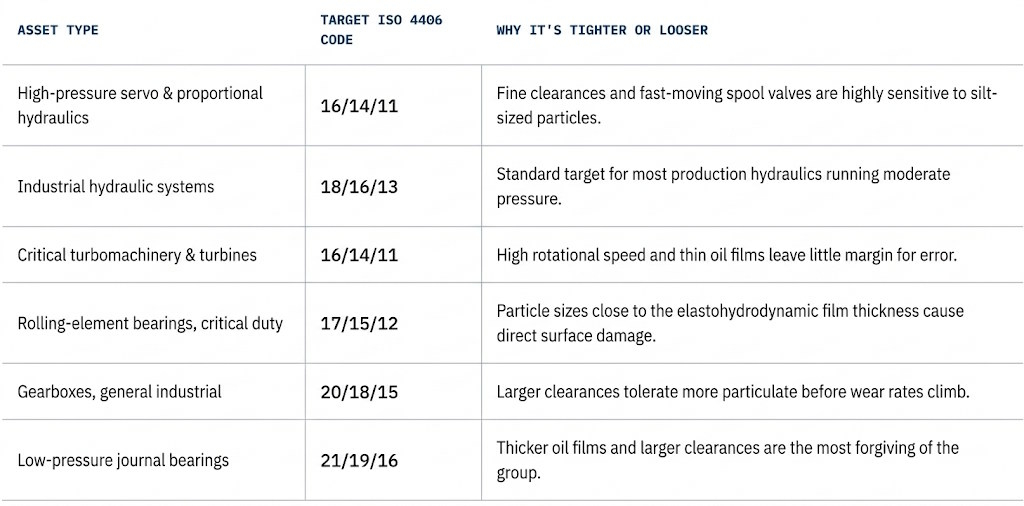
A code is only useful if you're actually measuring against it. Pair each target with a monitoring method; inline particle counter for continuous critical assets, portable counter for spot checks, laboratory analysis for trending over time.
SELF-ASSESSMENT
Is cleanliness actually controlled, or just assumed?
• Is every lubricant stored in closed, labelled, weatherproof containers?
• Is new oil filtered before first use, even from sealed drums?
• Are transfer containers dedicated per lubricant type, with no shared funnels?
• Are hoses and nozzles capped when not in use?
• Does each critical asset have a defined ISO 4406 cleanliness target?
• Is cleanliness measured with particle counters or oil analysis, not just a visual check?
• Are storage areas inspected and cleaned on a set schedule?
If you're relying on "it looks clean" for any of the above, contamination is already getting through somewhere in the chain.
HOW THIS FITS INTO LUBRICATION RELIABILITY™
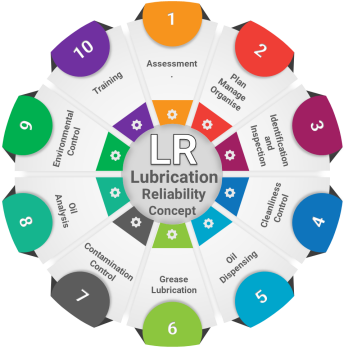
① Assess & Benchmark
② Organise & Plan
③ Identify & Inspect
4 Cleanliness Control
⑤ Dispense Precisely
⑥ Grease Effectively
⑦ Control Contamination
⑧ Condition Monitoring
⑨ Environmental Control
⑩ Knowledge Management
Step 3 tells you where to look and what to find.
Step 4 sets the standard you're checking it against.
Get cleanliness right here, and Step 5's dispensing equipment isn't fighting a losing battle before the oil even leaves the drum.
A proactive approach to cleanliness pays off
Cleanliness control is more than a maintenance checklist item; it's a philosophy that protects your investment and boosts reliability. By integrating best practices at every stage of the lubricant lifecycle, you significantly reduce downtime, increase equipment life, and lower total maintenance costs.
Define target cleanliness levels for every asset class before the next oil change.
Define target cleanliness levels for every asset class before the next oil change.