Step 5 of 10: Lubricant Dispensing and Transfer

DISPENSE WITH PRECISION
DISPENSE WITH PRECISION
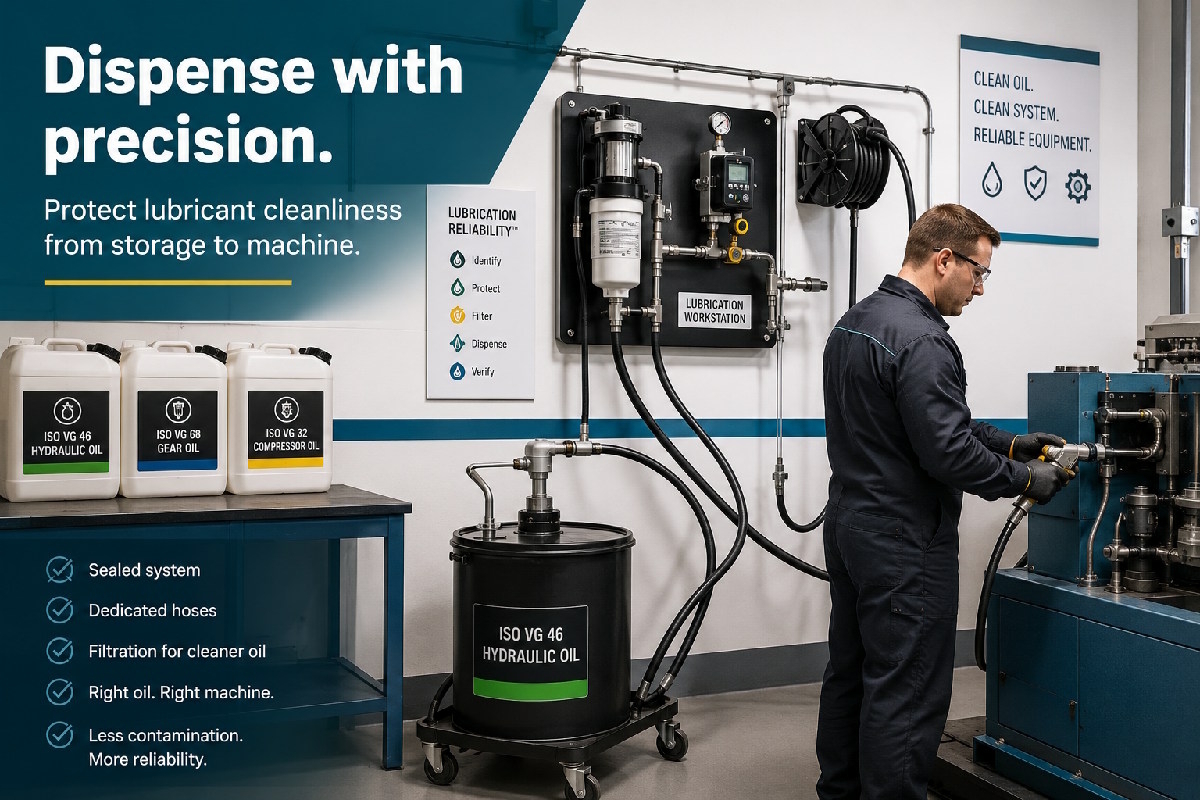
Clean storage and careful cleanliness control are undone in seconds by an open funnel. Step 5 controls the last, riskiest handoff - the moment lubricant moves from container to machine.
PRIMARY RISK
Contamination at the point of transfer
GOVERNS
Transfer equipment, dispensing systems, lids
FEEDS INTO
Step 6 - Grease Effectivity
WHY IT MATTERS
THE MOST-OVERLOOKED SOURCE OF CONTAMINATION
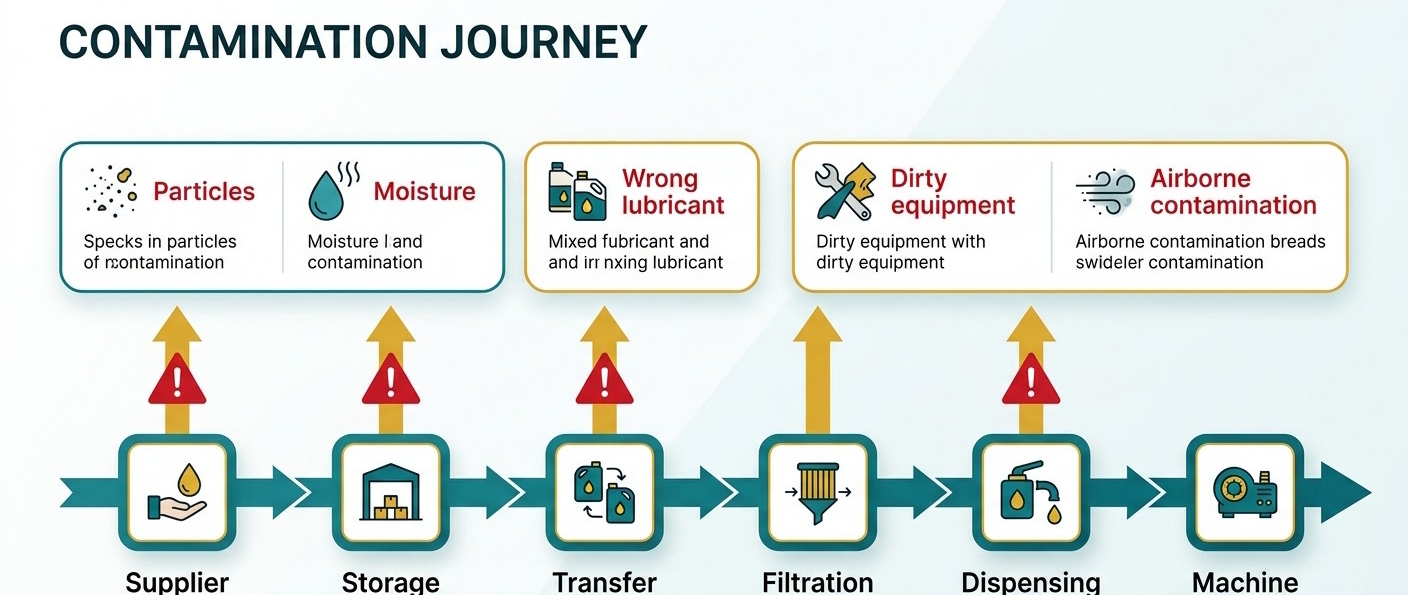
Step 4 controls cleanliness through storage and filtration. But even lubricant stored in optimal conditions can pick up dust, moisture and particles the moment it's poured, pumped or funnelled toward the machine. In many facilities, improper handling during transfer is a major, and often overlooked, source of contamination, undoing everything upstream in seconds.
"CAN I JUST USE A FUNNEL AND OPEN CONTAINERS?"
SHORT ANSWER: NO.
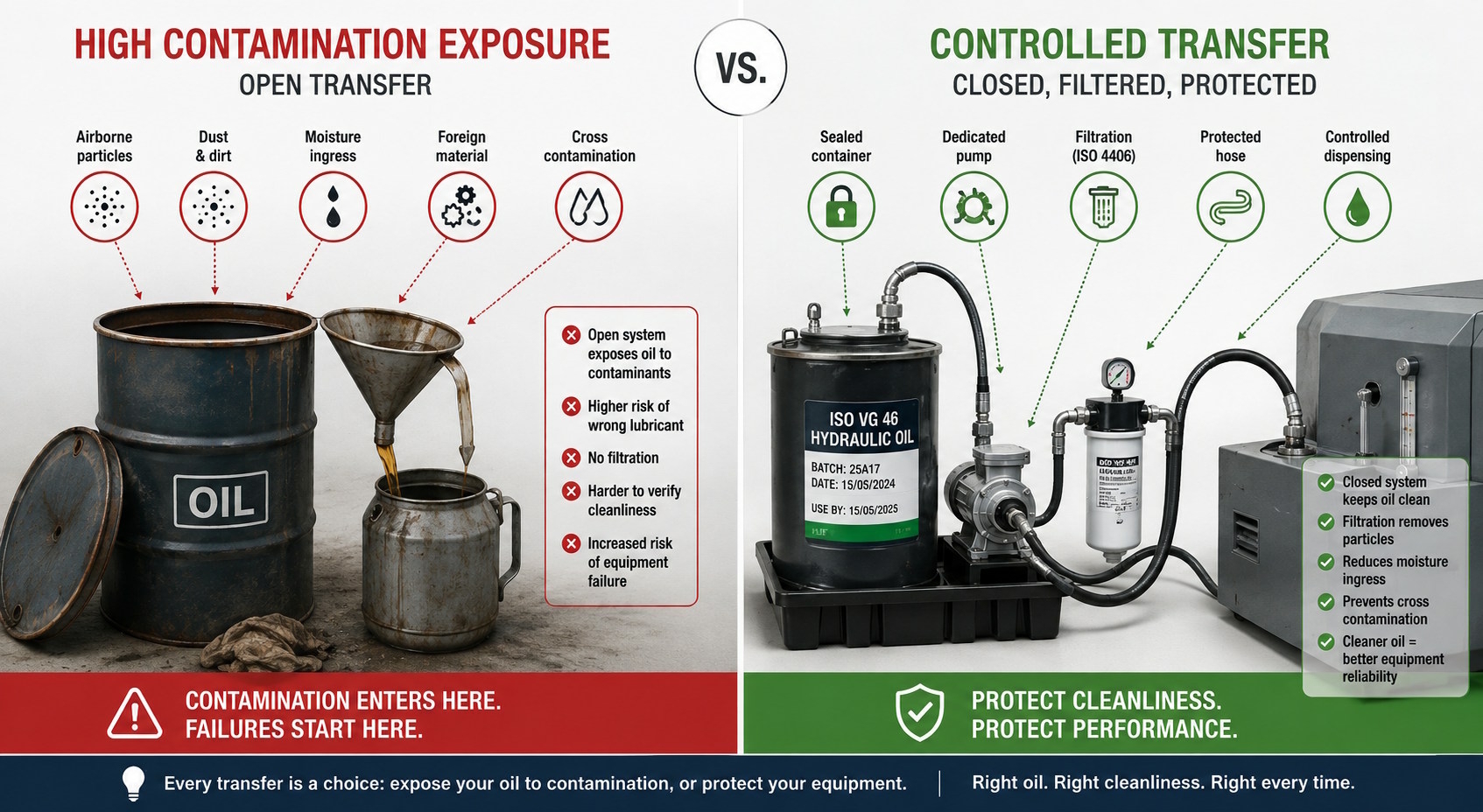
Open containers and shared funnels are one of the fastest ways to compromise lubricant quality; they expose the product to airborne particles, dirt and moisture, especially in industrial environments. A closed, sealed transfer system with filtration built in is far more effective at keeping lubricants clean and preserving their intended performance.
WHAT CLEAN TRANSFER ACTUALLY LOOKS LIKE
A SEALED, CLOSED-LOOP PROCESS
Clean transfer is a sealed process, not a set of good intentions. A compliant system is built from four components working together:
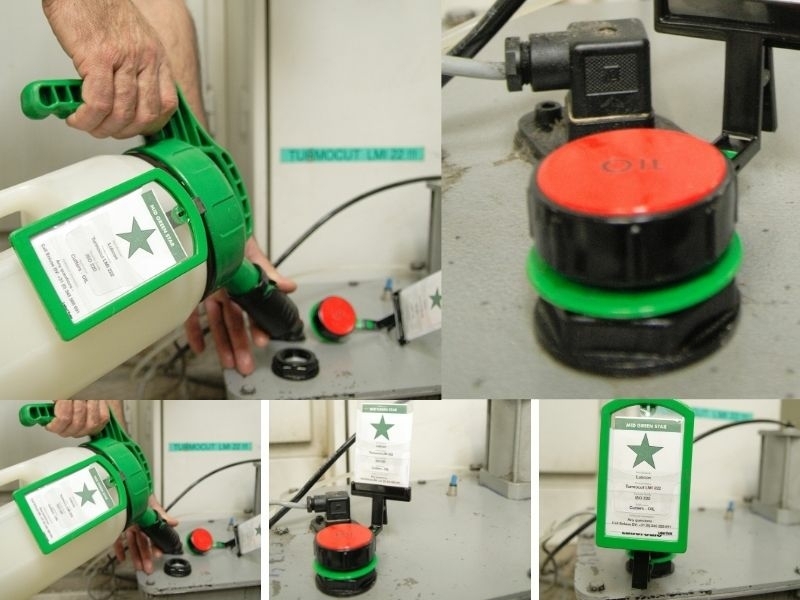
- Dedicated, labelled containers - one container, one lubricant, for life. No shared cans between products.
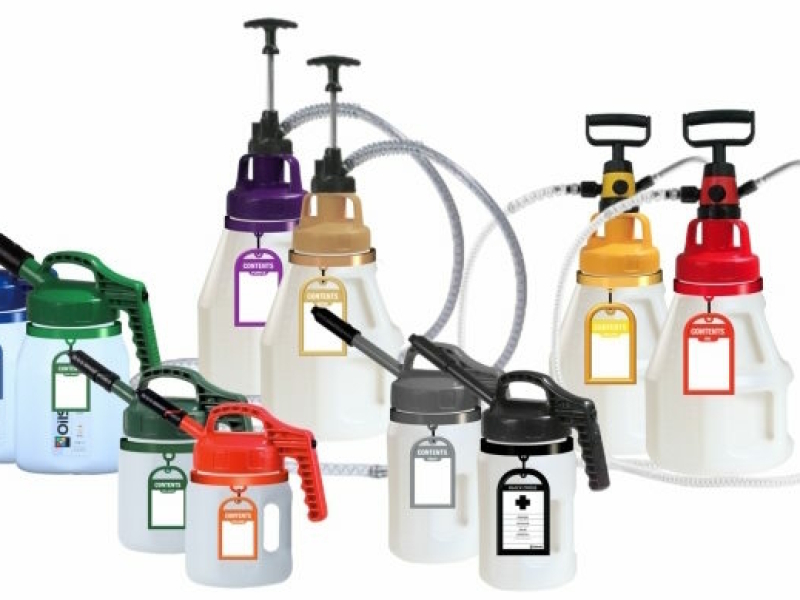
- Sealed or pressurised dispensing - purpose-built lids close the loop and keep airborne contamination out during pour, pump or gravity-feed.
- Colour-coded / tagged equipment - hoses, lids and containers keyed by lubricant family to make cross-contamination physically difficult, not just procedurally forbidden.
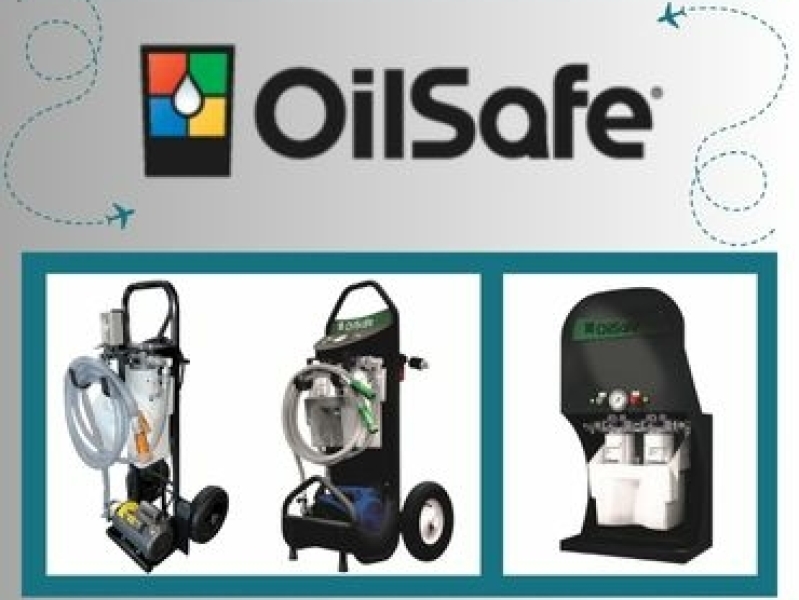
- Filtration during transfer - removing contaminants before they ever reach the machine
CHOOSE THE RIGHT LID FOR EVERY TASK
A transfer system is only as good as the components behind it. OilSafe® lids are purpose-built per dispensing need, reducing the risk of contamination and cross-use; each lid type is matched to a specific task rather than one lid doing every job.
Read the ins and outs about OilSafe lids

Setting up best-in-class transfer systems
FILTRATION: THE NON-NEGOTIABLE STEP
Filter every lubricant at the point of transfer; including new oil straight from the supplier. Contaminants are routinely introduced during transport, storage and even packaging, so "new" is not the same as "clean." Filtration during transfer reduces abrasive wear, extends component life, and is the only way to hold a lubricant to a stated ISO 4406 cleanliness code rather than a visual guess.
| Application | Typical target ISO 4406 | Notes |
|---|---|---|
| Servo / proportional hydraulics | 16/14/11 | Tightest tolerance - precision valves are highly sensitive to particulate. |
| General industrial hydraulics | 18/16/13 | Standard target for most fixed-displacement hydraulic systems. |
| Industrial gearboxes | 19/17/14 | Loosen or tighten based on gear precision class and load. |
| Steam / gas turbines | 16/14/11 | Journal and thrust bearing clearances demand very fine control. |
| Compressors (rotary & reciprocating) | 18/16/13 | Adjust for oil-flooded vs. oil-free designs. |
| Diesel / large engines | 18/16/13 | Cross-check against OEM crankcase oil cleanliness spec. |
Codes shown as ISO 4406 µm≥4 / ≥6 / ≥14 per mL. These are commonly referenced starting points; always confirm the actual target against the OEM or component manufacturer specification before setting a filtration plan.
Precision Lubrication Starts with Lubristation™
Eliminate Cross-Contamination and Achieve ISO 4406 Cleanliness Standards
KEEP THE TRANSFER PATH CLEAN
A FILTRATION SYSTEM CANNOT COMPENSATE INDEFINITELY FOR A CONTAMINATED TRANSFER PATH
Every component between the storage container and the machine should be treated as part of the contamination-control system.
Control the transfer path:
- Dedicated equipment
Use dedicated hoses, pumps, containers and dispensing equipment for each lubricant or lubricant family where practical. - Clean connections
Use closed or sealed connections wherever possible. Quick-connect couplings can minimise exposure during connection and disconnection. - Protected hoses
Keep hoses capped or otherwise protected when not in use. Never allow hose ends to rest on dirty floors or surfaces.
- Clean dispensing points
Use clean, controlled dispensing equipment rather than open pouring. - Correct identification
Use clear labels, colour coding and/or machine identification to prevent cross-contamination and wrong-lubricant application. - Seal integrity
Inspect drums, containers, lids, caps, fittings and couplings before use.
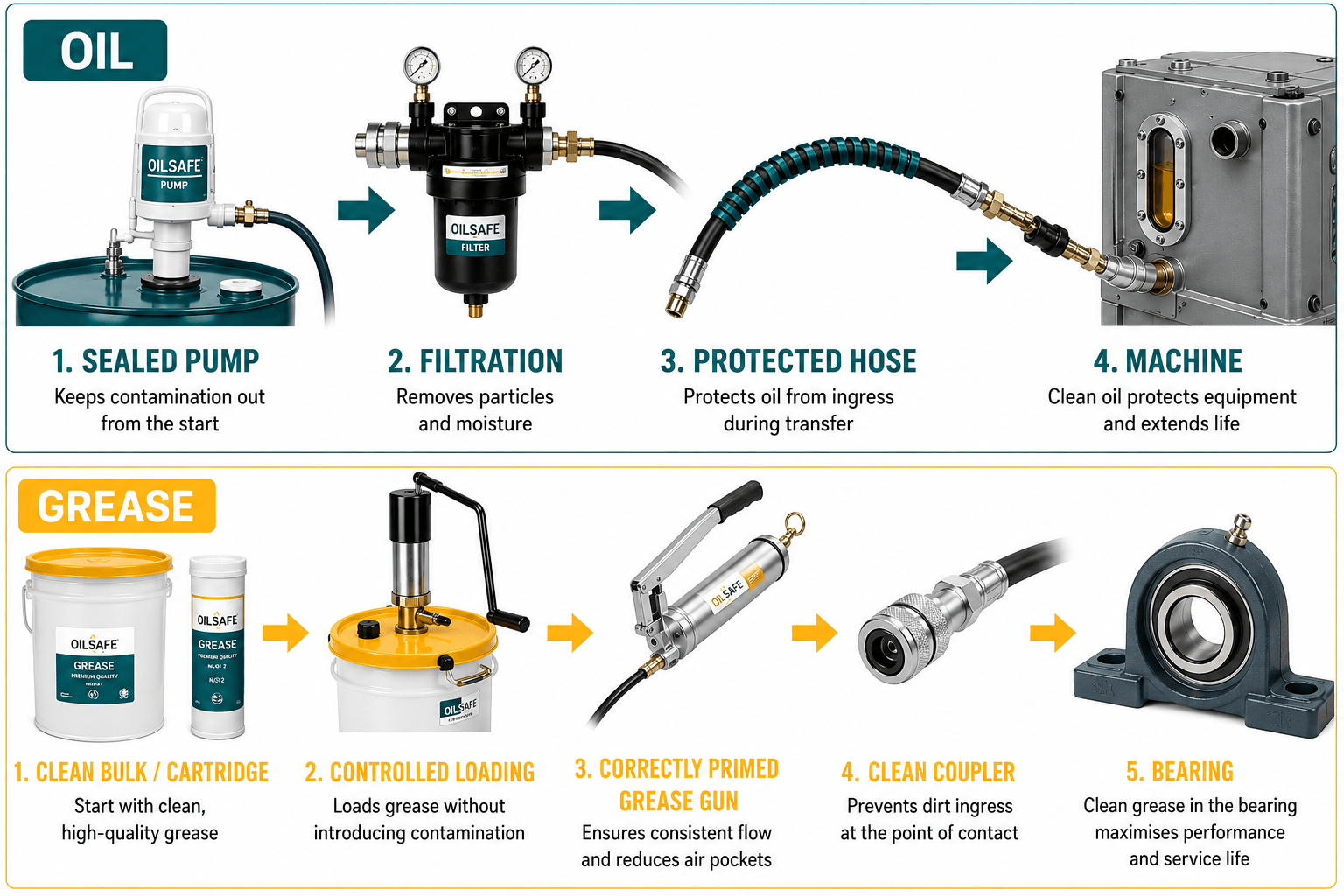
OIL AND GREASE ARE NOT THE SAME DISCIPLINE
Most transfer guidance is written for oil. Grease dispensing carries its own, equally common, failure modes.
OIL TRANSFER
- Filter in-line during every transfer, including new oil.
- Check breather condition on bulk tanks before drawing off — a saturated or missing breather undoes upstream filtration instantly.
- Confirm container material compatibility, particularly with synthetic base oils and EP additive packages that can attack certain plastics.
- Verify the lubricant ID tag against the machine tag before connecting the hose.
GREASE TRANSFER
- Load cartridges under pressure to avoid trapped air pockets, which cause inconsistent output and false "full" readings at the gun.
- Prime grease guns fully before use — an unprimed gun leads operators to over-pump, masking the real issue.
- Never mix greases with incompatible thickener types (e.g. lithium complex with polyurea) even "just this once" — the result can be a softened, non-functional grease.
- Colour-code cartridges and guns by grease type with the same rigour used for oil containers.
TRAINING AND PROCEDURES MATTER AS MUCH AS EQUIPMENT
Even the best tools won't deliver results if used improperly. Maintenance personnel should be trained on:
Identification systems
Identification systems
Reading and following colour, tag and label schemes without relying on memory.
Equipment operation
Equipment operation
Correct use of lids, couplers, filter carts and sealed containers for each lubricant family.
Cross-contamination awareness
Cross-contamination awareness
Why "just this once" with a shared hose or funnel undoes upstream storage and filtration work.
Standardised operating procedures should be created and enforced so consistency doesn't depend on who's on shift.
SELF-ASSESSMENT
Is your transfer process actually sealed, or sealed "most of the time"?
- Is every lubricant transferred through a dedicated, sealed container; never a shared funnel?
- Is transfer equipment colour-coded or tagged to match the storage system from Step 4?
- Is new oil filtered at transfer, even straight from a sealed drum?
- Are the correct OilSafe (or equivalent) lids matched to each dispensing task?
- Are all personnel trained on transfer procedures, not just handed the equipment?
- Is filtration during transfer tracked toward a defined ISO 4406 target?
A single open funnel in the wrong hands undoes a well-run Step 4; this is the step where clean lubricant most often gets dirty again.
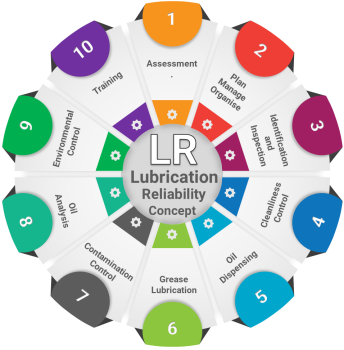
HOW THIS FITS INTO LUBRICATION RELIABILITY™
① Assess & Benchmark
② Organise & Plan
③ Identify & Inspect
④ Cleanliness Control
5 Dispense Precisely
⑥ Grease Effectively
⑦ Control Contamination
⑧ Condition Monitoring
⑨ Environmental Control
⑩ Knowledge Management
Step 4 sets the cleanliness standard.
SMALL STEPS - BIG IMPACT
Lubricant transfer might seem like a small part of the overall lubrication strategy, but its impact on equipment reliability is significant.
By investing in the right tools, training and procedures, you take a major step toward a world-class lubrication reliability programme.