Grease

Industrial grease explained: composition, types and applications

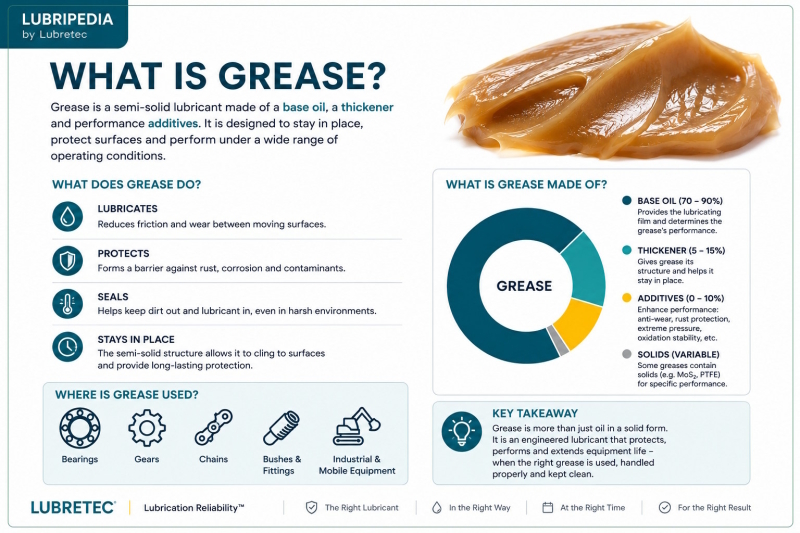
In industrial maintenance, grease is far more than just "thick oil"- it is a purpose-engineered, semi-solid lubricant designed to stay in place where liquid oil would leak, wash away, or fail to provide adequate protection.  

The Basic Composition

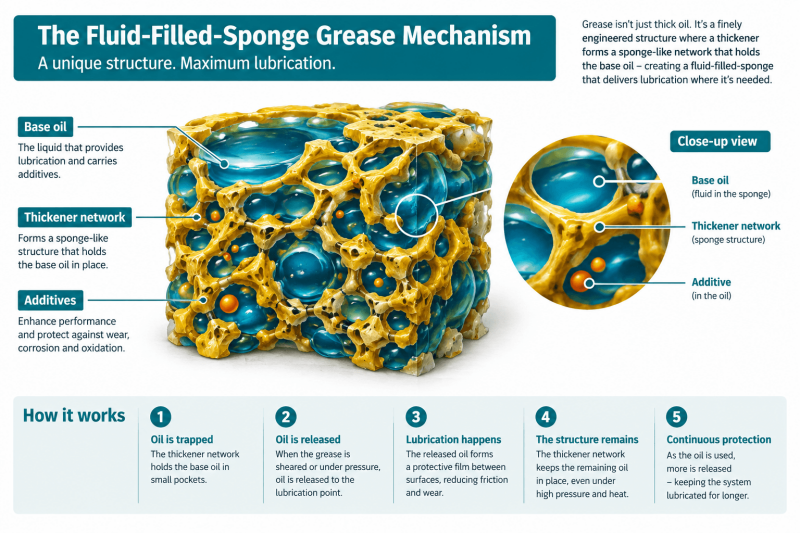
Grease functions like a fluid-filled sponge. The matrix or structure holds the oil and additives in suspension, releasing the fluid to lubricate under friction and dynamic load, then reabsorbing it as movement stops. Its composition breaks down into three key ingredients:  

Base Oil (60% – 75%): The primary fluid responsible for doing the actual work of lubrication.Can be mineral, synthetic, or bio-based.  

Thickener (5% – 25%): The chemical "sponge" structure.Usually metallic soaps (e.g., Lithium, Calcium, Aluminum complex) or non-soaps (e.g., Polyurea, Clay).  

Additives (5% – 20%): Performance enhancers that provide Anti-Wear (AW), Extreme Pressure (EP) resistance, anti-corrosion, or oxidation stability. 


How it works

Oil is held in the structure
The thickener network retains the base oil in small spaces.

Oil is released during operation
Friction, load, temperature and mechanical action allow oil to move to the lubricating interface.

Lubrication takes place
The released oil forms a protective film between moving surfaces, reducing friction and wear.

The grease remains in place
The thickener helps keep the lubricant where it is needed.

Lubrication continues
The grease reservoir can continue supplying oil over time, provided the grease remains suitable for the application.

Fluid-filled sponge grease mechanism

When to use Grease vs. Oil


Factor

Grease

Oil

Sealing Capability

Acts as a secondary physical seal against dirt and moisture.

Requires mechanical seals to prevent leakage.

Retention

Stays localized on unsealed or open components.

Gravity causes it to drip and run off exposed surfaces.

Cooling & Heat  

Poor thermal dissipation.

Excellent heat transfer and cooling properties.

Re-application 

Ideal for intermittent or hard-to-access lube points.

Best for continuous recirculation and filtering systems.


Why it matters for Lubrication Reliability™

From a plant reliability perspective, applying the wrong grease or failing to manage re-lubrication intervals is a leading cause of premature bearing failure. Ensuring the Right Grease is matched with the Right Quantity at the Right Timeminimizes friction, eliminates solid contamination ingress, and maximizes asset lifespan.


What is grease?