OSHA / Local WHS: Workplace Labelling & Hazard Communication for Lubricants

In industrial plants and manufacturing facilities, proper chemical and lubricant hazard communication is not just a best-practice requirement—it is a critical legal compliance standard. Regulatory bodies like OSHA (Occupational Safety and Health Administration) in the United States and Work Health and Safety (WHS) authorities across Europe and Australia mandate strict workplace labelling, handling protocols, and safety data availability for all industrial chemicals, including oils, greases, solvents, and coolants.

Within a structured Lubrication Reliability program, aligning your lubricant storage, dispensing, and visual identification systems with OSHA and local WHS standards ensures both worker safety and audit readiness.

1. Regulatory Frameworks: GHS Alignment

  • Modern workplace hazard communication relies on the Globally Harmonized System of Classification and Labelling of Chemicals (GHS), integrated into regional legislation:
  • OSHA HazCom 2012 (29 CFR 1910.1200): Mandates that all hazardous chemicals in US workplaces carry standardized GHS labels and that Safety Data Sheets (SDS) are immediately accessible to employees.
  • European CLP Regulation (EC 1272/2008) / Local WHS: Governs chemical classification, labelling, and packaging across European and national health and safety frameworks.

Primary Workplace Requirements:

  1. Safety Data Sheets (SDS): Up-to-date SDS documents must be readily accessible in the workspace for every lubricant, grease, or solvent used on-site.
  2. Container Labelling: Every container—from bulk storage tanks down to secondary transfer containers (such as OilSafe bottles or grease guns)—must be clearly labelled.
  3. Employee Training: Maintenance personnel must be trained to read GHS pictograms, signal words (DANGER, WARNING), hazard statements, and precautionary measures.

2. Primary vs. Secondary Container Labelling Rules

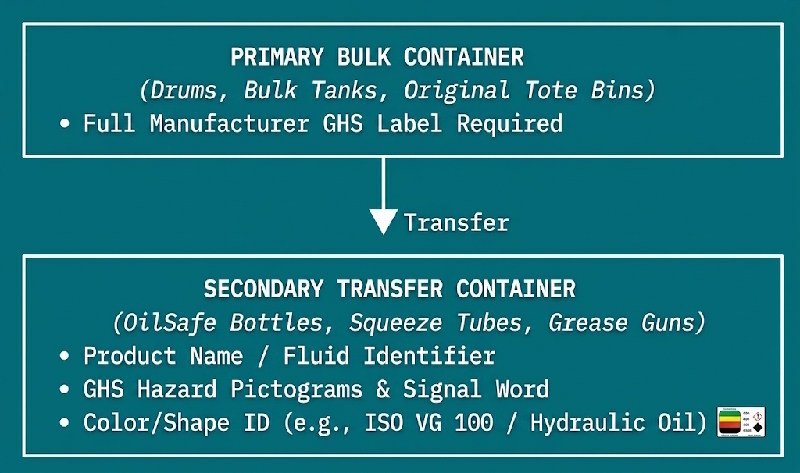
A common compliance pitfall in industrial facilities occurs when bulk lubricants are transferred into portable containers for application. 

Primary vs. Secondary Container Labelling Rules
  • Primary Containers: Must retain the manufacturer’s full, original GHS label throughout their lifecycle.
  • Secondary Containers: Whenever a lubricant is transferred into a portable container, that container must be labelled unless it is intended for immediate, single-shift use by the employee who performed the transfer. To maintain compliance and prevent cross-contamination, secondary containers should display:
  • Chemical / Brand product name
  • Applicable GHS hazard pictograms
  • Specific viscosity / fluid classification
  • Color and shape identification codes

3. Integrating OSHA/WHS Labelling with Lubrication Reliability

While safety compliance focuses on preventing exposure and accidents, Lubrication Reliability™ focuses on eliminating lubricant cross-contamination and application errors. Fortunately, both objectives rely on the same core tool: Clear, Standardized Visual Identification.


Integrated Workplace Labelling System

OSHA / WHS Compliance

  • GHS Hazard Pictograms
  • Signal Words & Hazards
  • Health & Environmental Risk

Lubrication Reliability

  • Color-Coded Lids & Labels
  • Viscosity / Fluid Symbols
  • Asset Machine Match Tags


By utilizing integrated tagging systems — such as color-coded OilSafe transfer lids, drum tags, and matching machine point labels — facilities simultaneously satisfy regulatory safety requirements and ensure the correct oil goes into the correct machine every time.