
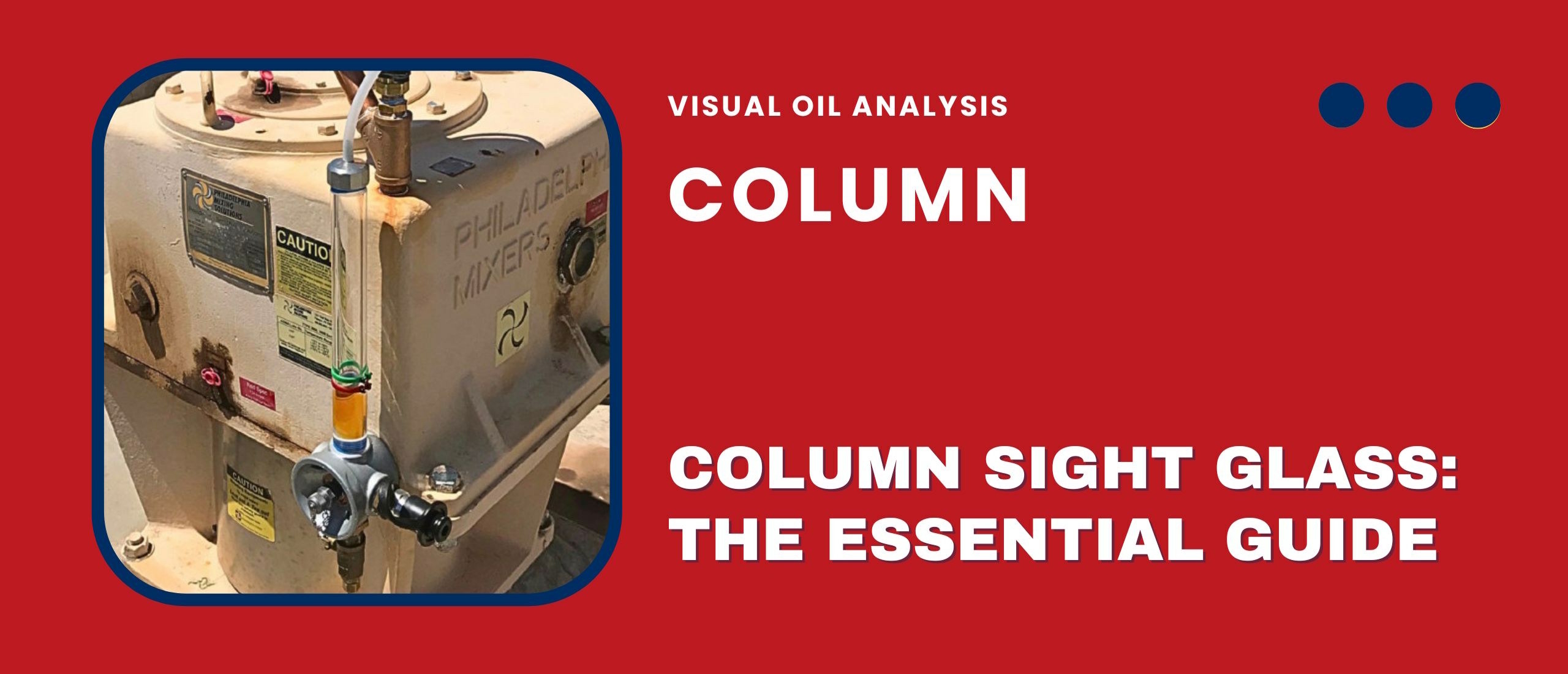
Luneta Column Sight Glass: The Essential Guide
Every unplanned equipment stoppage has a root cause. In the majority of industrial machinery failures, that root cause is lubrication-related - insufficient oil, contaminated lubricant, or a problem that could have been spotted days or weeks earlier with the right monitoring tool in place. Yet across manufacturing plants, power stations, and processing facilities worldwide, maintenance teams still rely on dipsticks and rudimentary gauges that tell you only one thing: whether oil is present. They tell you nothing about its condition.
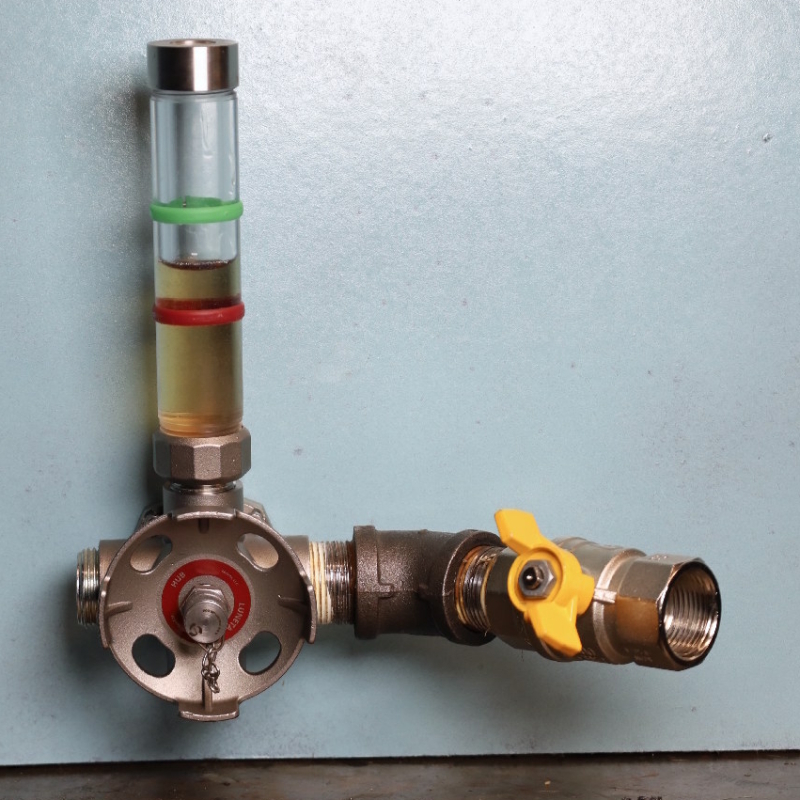
The Luneta Column sight glass changes that. Designed as a 3D columnar oil level indicator, the Column offers continuous, real-time visibility into both oil level and lubricant condition - mounted directly to the drain port or below the oil line of your equipment. It is one of the most practical, cost-effective tools available within the lubrication reliability toolkit, and yet it remains underutilised across the maintenance sector.
This guide provides everything decision-makers and maintenance professionals need to know about the Luneta Column sight glass: how it works, why it matters, where to deploy it, how to install it correctly, and how to integrate it within a broader proactive maintenance programme.
What Is a Column Sight Glass?
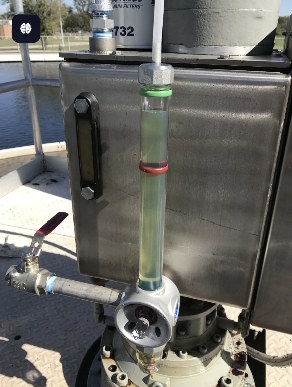
A columnar sight glass - also referred to as a sight tube or sight gauge - is a transparent cylindrical device mounted vertically on industrial equipment to allow operators to observe the level, quality, and condition of lubricating oil or other process fluids at a glance. Unlike a flat sight glass embedded in an equipment housing, a column sight glass protrudes from the machine and provides a full-length, three-dimensional view of the fluid within.
The critical distinction between a standard oil level indicator and a column sight glass lies in what you can actually see. A traditional dipstick or flat gauge tells you whether oil is present. A column sight glass lets you see water ingress collecting at the bottom, foam forming at the surface, sedimentation building up over time, and whether oil colour has changed - all without opening the machine or shutting down production.
The Luneta Column: Design, Features, and Specifications
The Luneta Column sight glass is engineered specifically for industrial environments where oil levels fluctuate between idle and running conditions. Its design addresses a common limitation of traditional flat sight glasses: the inability to track dynamic fluid levels across a range of operating states.
Tritan : The Material Advantage
The Column body is manufactured from Tritan, an advanced copolyester material that delivers crystal-clear transparency, exceptional impact resistance, and broad chemical compatibility with mineral and synthetic oils. Compared to traditional glass sight gauges, Tritan offers a dramatically reduced risk of breakage in field conditions - a significant safety and operational advantage in busy industrial environments. Tritan also provides UV resistance, making the Column a reliable choice for outdoor or partially exposed installations.
Intelligent Level Monitoring with Colour-Coded Rings
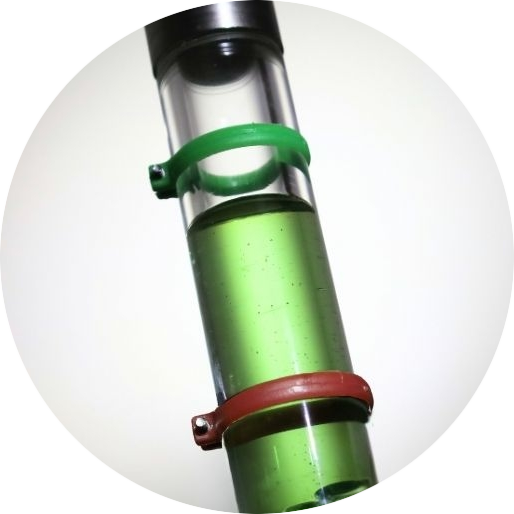
Included with every Luneta Column is a set of red and green level rings manufactured from high-strength nylon. These are positioned on the column body to indicate the acceptable oil level at idle and at running conditions respectively - two distinct states that many machines exhibit due to oil circulation. The rings feature a tamper-proof design, preventing accidental repositioning and ensuring that your monitoring benchmarks remain accurate over time.
Breather and Vent Tube Options
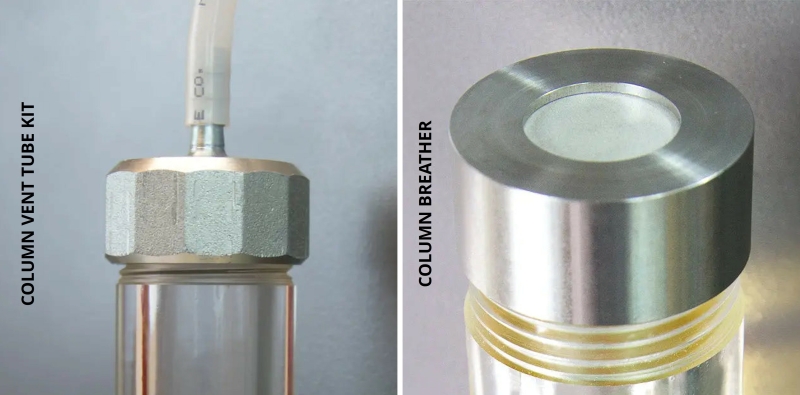
The upper connection point of the Column is available in two configurations:
- Vent Tube Kit - connects the Column back to the headspace of the oil reservoir, preventing vacuum lock and ensuring smooth oil movement within the column during operation. This is the configuration recommended for most installations.
- Breather Option - a 3-micron stainless steel filter breather that prevents airborne contaminants, water, and particulate from entering the column and the machine. A silicone breather cap is recommended alongside this option to prevent dust and moisture accumulating on top of the breather screen.
Technical Specifications at a Glance
| Specification | Detail |
Available Lengths | 3" to 60" (3", 6", 9", 12", 15", 18", 24", 36", 48", 60") |
Thread Size | 1" NPT (thread reducers included for 3/8", 1/2", 3/4" ports) |
Operating Pressure | Up to 65 psi (4.5 bar) |
Temperature Range | -20°F to 200°F (-29°C to 93°C) |
Body Material | Tritan® copolyester (crystal-clear, impact-resistant, UV-stable) |
Level Rings | High-strength nylon, tamper-proof |
Thread Reducer | Stainless steel |
Chemical Compatibility | Mineral and synthetic oils compatible with Viton® and PMMA® |
Outdoor Use | UV-resistant for long-term sun exposure |
Why Lubrication Reliability Is a Business-Critical Priority
Industry analysts consistently highlight lubrication failure as one of the top causes of premature bearing and gearbox failure, accounting for an estimated 40–50% of all rotating equipment breakdowns. The cost consequences are considerable: unplanned downtime in manufacturing environments typically costs between €5,000 and €30,000 per hour when lost production, labour, and equipment damage are accounted for.
The shift from reactive maintenance - fixing things when they break - to proactive and predictive maintenance has been ongoing for decades, yet many facilities still lack the most basic tool required for proactive lubrication management: continuous, visual access to oil condition. A column sight glass costs a fraction of a single breakdown event, yet delivers ongoing protection by making problems visible before they become failures.
| The business case for column sight glasses: ✔ 40–50% of rotating equipment failures are lubrication-related ✔ Unplanned downtime costs €5,000–€30,000 per hour in manufacturing ✔ Column sight glasses are priced a fraction of a single repair event ✔ Visual oil condition monitoring requires no complex sensors or data infrastructure ✔ Proactive identification of water, foam, or sediment prevents catastrophic damage |
The Real-Time Advantages of the Luneta Column Sight Glass
Spot Contamination Before It Causes Damage
Because the Column is mounted at or near the drain port - the lowest point of the reservoir - it acts as a natural collection point for water, sediment, and heavy contaminants that settle by gravity. Operators performing routine walkabouts can immediately identify:
- Water ingress - visible as a clear, separated layer at the base of the column
- Foaming - foam floating and lingering at the top of the oil column, indicating aeration or incorrect oil specification
- Darkening or discolouration - signalling thermal degradation or excessive contamination
- Sedimentation - solid debris collecting in the lower section, ready for safe draining
These are precisely the conditions that destroy bearings and seals when left undetected. The Luneta Column sight glass makes them impossible to miss.
Monitor Level Fluctuations Between Idle and Running Conditions
Many machines exhibit a measurable difference in oil level between standstill and full-speed operation, as oil circulates through pipework, coolers, and bearing housings. A standard sight glass captures a snapshot; the Luneta Column captures both states simultaneously with its red and green level rings. Maintenance teams can confirm at a glance that oil levels remain within acceptable bounds across the full operational cycle - without waiting for a machine to stop, cool, and equalise.
Integrate with Your Broader Lubrication Programme
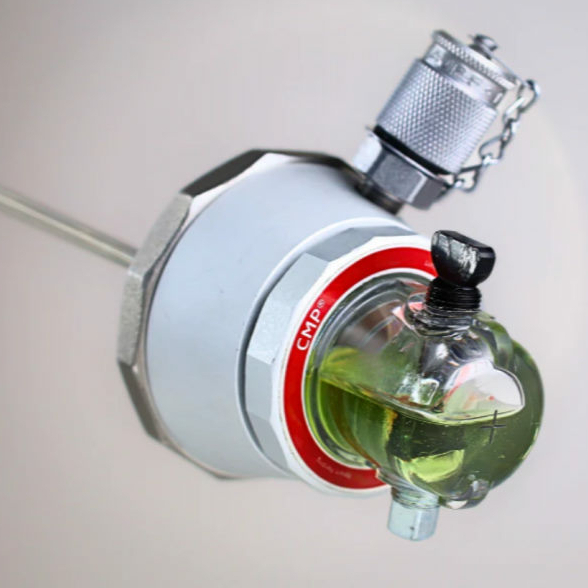
The Luneta Column is designed to work in conjunction with other Luneta products. It pairs naturally with the Luneta Hub - a multi-port connection block that consolidates sampling, breather, and monitoring points - and the Luneta Bowl drain port sight glass. For facilities operating oil filter carts, a bypass tubing kit enables the Column to be integrated into kidney-loop filtration workflows. The Luneta Condition Monitoring Pod (CMP) can further extend this ecosystem by adding oil sampling and particle counting capability to the same machine port.
Industry Applications: Where the Luneta Column Delivers Most Value
The Luneta Column sight glass is suitable for any stationary industrial asset where oil levels require consistent monitoring. Key sectors include:
- Power Generation - turbines, pumps, gearboxes, and compressors where lubrication failure has immediate safety and operational consequences
- Manufacturing & Heavy Industry - hydraulic systems, presses, and CNC equipment running continuous shift patterns where unplanned downtime is especially costly
- Food & Beverage Processing - where clean lubricant is essential for both machinery reliability and compliance with food safety regulations
- Marine & Offshore - where water contamination of lubricant is a persistent risk in high-humidity, salt-laden environments
- HVAC & Refrigeration - where refrigerant and lubricant monitoring within closed systems demands non-invasive visual inspection capability
- Chemical & Petrochemical - where early detection of contaminated or degraded process fluids prevents safety incidents and expensive equipment damage
Step-by-Step: How to Install and Use the Luneta Column
Correct installation takes less than 30 minutes and requires only basic hand tools. Follow these steps carefully to ensure a leak-free, accurate installation:
- Remove the protective plastic sleeve and clear any debris from inside and outside the Column body.
- Select the appropriate stainless steel thread reducer from those supplied (3/8", 1/2", 3/4", or 1" NPT) to match your machine's drain port thread.
- Apply a thread sealer compatible with Tritan to the thread reducer and install it into the machine's vertical port. Tighten with a wrench to the appropriate torque.
- Apply thread sealer to the Column base threads and hand-tighten the Column into the reducer. Use a strapping wrench if additional torque is needed. Do not use metal pliers or pipe wrenches directly on the Column body.
- Slide the colour-coded level rings onto the Column and position them at the appropriate idle and running oil levels for your machine. Tighten using the supplied hex key — firm but not over-tightened.
- Install either the vent tube kit (routing back to the reservoir headspace or a desiccant breather at the machine's breather port) or the 3-micron breather option with silicone cap at the top of the Column.
- Check the Column daily during routine maintenance walks. A single visual glance confirms oil level, oil condition, and absence of contamination.
Note: For any Column longer than 18", it is recommended adding mechanical support to prevent vibration-induced stress on the fitting.
Common mistakes to avoid with Column Sight Glasses
Even a well-chosen monitoring tool delivers no value if it is installed or managed incorrectly. These are the most frequent errors observed in the field:
Over-tightening: Using a metal wrench directly on the Tritan body risks cracking the transparent section. Always use a strapping wrench on the Column body and apply sealant properly so that excessive torque is not required to achieve a seal.
Skipping the silicone breather cap: When using the breather option, a silicone cap over the top is essential. Without it, dust, particulate, and moisture accumulate on the 3-micron screen and obstruct airflow — the Column cannot breathe properly, and vacuum effects distort your oil level reading.
Installing horizontally: The Luneta Column is designed for vertical installation. Horizontal or angled mounting compromises level accuracy and makes contamination detection far less effective.
Ignoring the reading: A sight glass only delivers value if it is checked regularly. Incorporate Column inspection into your standard daily or shift walkabout rounds. Without a consistent checking routine, you lose the proactive advantage entirely.
Using incompatible solvents during cleaning: Tritan is chemically resistant to mineral and synthetic oils but can be damaged by certain solvents. Always confirm solvent compatibility before any cleaning operation.
Neglecting to add cavitation bypass: On high-flow systems, fitting the Luneta Column bypass accessory prevents cavitation from occurring inside the machinery — a step worth taking on any high-demand application.
Column vs Bullseye vs Bowl: Choosing the Right Sight Glass
Luneta offers three primary sight glass formats. The right choice depends on your application, fluid behaviour, and space constraints:
Specification | Detail |
Sight Glass Type | Best Application |
Column (sight tube) | Equipment with significant oil level fluctuations; drain-port monitoring; where contamination detection is a priority |
Bullseye (3D ball) | Standard oil level check on stable systems; easy visual confirmation from multiple angles; compact installations |
Bowl (magnifying) | Drain port analysis; highly detailed oil condition assessment; where sediment and water separation must be inspected closely |
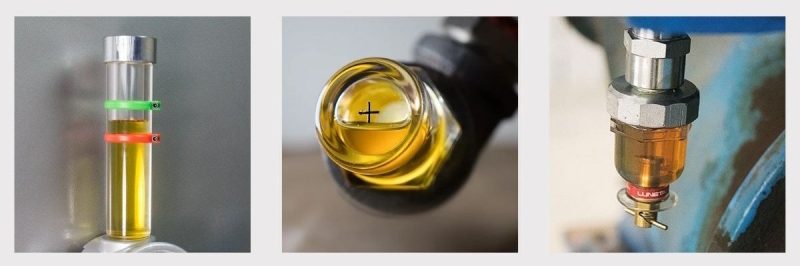
For equipment with greater level fluctuations - gearboxes, large reservoirs, hydraulic systems, and machines where oil circulates extensively during operation - the Column sight glass is the clear choice. Its length and cylindrical format provide a far wider monitoring window than a fixed bullseye or bowl, and its position at the drain port makes it the first place contamination will become visible.
Future Trends: Condition Monitoring and the Connected Lubrication Programme
The maintenance sector is moving rapidly towards condition-based and predictive maintenance strategies, driven by Industry 4.0 frameworks, increasing asset criticality, and the rising cost of skilled maintenance labour. Visual oil monitoring tools like the Luneta Column sit at the foundation of this evolution - providing the human-readable data layer that feeds into broader condition awareness.
Luneta is already bridging the gap between visual monitoring and data-driven maintenance through its Condition Monitoring Pod (CMP), which can be paired with Column installations to add oil particle counting, water detection, and viscosity sensing. As IoT sensor costs continue to fall, we can expect Column-style installations to serve increasingly as integration points for digital condition data - combining what engineers can see with what sensors can measure.
Equally significant is the growing emphasis on contamination control across the full lubrication chain: from storage and transfer to machine application. The Luneta Column, when paired with desiccant breathers and sealed oil transfer systems, represents one component of a complete contamination exclusion programme - the standard now expected by leading maintenance operations pursuing ISO cleanliness targets.
Conclusion: See More, Protect More, Spend Less
The Luneta Column sight glass is a deceptively simple tool that delivers disproportionate value within any proactive maintenance programme. By providing continuous, real-time visibility into both oil level and lubricant condition at the most critical monitoring point - the drain port - it makes early detection of contamination, level drift, and oil degradation a routine part of every maintenance walkabout.
For maintenance engineers, reliability managers, and operations directors under pressure to reduce downtime, extend equipment life, and control maintenance costs, the Column is not an optional extra. It is a foundational element of responsible lubrication reliability - available from 3 inches to 60 inches in length, suited to virtually any industrial machine, and priced at a fraction of the first breakdown event it prevents.
The question is not whether your facility can afford to install Luneta Column sight glasses. The question is whether you can afford not to.
FAQ - Luneta Column sight glass
What is the Luneta Column sight glass used for?
The Luneta Column sight glass is a 3D columnar oil level indicator designed for industrial equipment where oil levels fluctuate between idle and running conditions. Installed at or near the drain port, it provides continuous, real-time visibility into oil level and lubricant condition - allowing maintenance teams to detect water ingress, foaming, sediment, and oil darkening without shutting down the machine.
What lengths and sizes is the Luneta Column available in?
The Luneta Column is available in lengths from 3 inches to 60 inches (3", 6", 9", 12", 15", 18", 24", 36", 48", and 60"). All versions feature a 1" NPT thread connection, with stainless steel thread reducers included to fit 3/8", 1/2", and 3/4" machine ports.
What material is the Luneta Column made from, and why does it matter?
The Column body is manufactured from Tritan, a premium copolyester chosen for its outstanding optical clarity, impact resistance, UV stability, and broad chemical compatibility with mineral and synthetic lubricants. Tritan does not crack or shatter under the field conditions that frequently damage traditional glass gauges, making it the material of choice for demanding industrial environments.
Can the Luneta Column be connected to a desiccant breather?
Yes. The Luneta Column's vent tube kit option is specifically designed to connect the Column to a desiccant breather at the machine's existing breather port location.
This ensures that any air displaced as oil levels change is filtered through a desiccant breather - preventing moisture and particulate from entering the system through the Column.
Luneta recommends the vent tube kit as the preferred configuration for most Column installations.
| Ready to Improve Your Lubrication Reliability? The Luneta Column sight glass is available now for immediate deployment across your facility. Don't wait for the next breakdown - make oil level and condition monitoring a daily habit. ▶ Speak to a lubrication reliability specialist today ▶ Request a product specification sheet ▶ Explore the full Luneta product ecosystem: Column, Bowl, Hub, and CMP |