Online vs. Offline Oil Condition Monitoring: Choosing the Right Strategy
As industrial maintenance strategies shift from reactive and time-based routines toward predictive and proactive reliability, oil condition monitoring (OCM) plays a pivotal role. Knowing the health of your lubricant directly reflects the health of your machine.
However, maintenance teams frequently face a tactical decision: When should you rely on periodic laboratory offline oil analysis, and when does continuous online sensor monitoring justify the investment?
Understanding the strengths, limitations, and practical applications of both methods allows plant managers to design an optimal, cost-effective condition monitoring program.
1. Defining the Approaches
Offline Oil Condition Monitoring (Laboratory Analysis)
Offline OCM involves periodically extracting a representative fluid sample from a machine valve or sampling point using clean extraction tools (such as vacuum sampling pumps and dedicated bottles) and sending it to an accredited laboratory or utilizing an in-house lab.
- Key Strengths: High analytical depth, precise chemical spectrometry, multi-element wear metal identification, and comprehensive degradation testing.
- Primary Role: Routine diagnostic health checks, root-cause failure analysis, baseline setting, and verifying oil cleanliness standards over extended periods.
Online Oil Condition Monitoring (Real-Time Sensors)
Online OCM utilizes inline, on-machine sensors mounted directly into fluid lines, reservoirs, or bypass loops to continuously measure lubricant parameters in real time.
- Key Strengths: Continuous data streaming, instantaneous anomaly detection, zero delay in trend monitoring, and immediate alarm triggers.
- Primary Role: Early warning detection for critical, high-risk assets, remote equipment, and rapidly deteriorating fluid conditions.
2. Parameter Comparison Matrix
While laboratory analysis provides full-spectrum insight, modern inline sensors provide real-time coverage for core parameters:
| Measured Parameter | Offline Laboratory Analysis | Online Sensor Technology |
| Particle Contamination | Laboratory optical particle counters (ISO 4406 / NAS 1638 calibration) | Inline optical or inductive particle counters and contamination monitors |
| Moisture Content | Karl Fischer Titration (ppm accurate down to free, emulsified, and dissolved) | Relative Humidity (% RH) / Dielectric sensors (measures saturation level) |
| Viscosity | Kinematic viscosity at 40°C & 100°C (ASTM D445) | Acoustic wave or micro-viscometer sensors |
| Wear Metals & Elements | Elemental Spectroscopy (ICP) measuring Fe, Cu, Pb, Al, Si, etc. | Metallic wear debris sensors (distinguishes ferrous vs. non-ferrous particles) |
| Oil Degradation & Additives | FTIR Spectroscopy, TAN (Total Acid Number), TBN (Total Base Number) | Dielectric constant permittivity sensors (detects overall oxidation trend) |
3. When to Choose Which Strategy
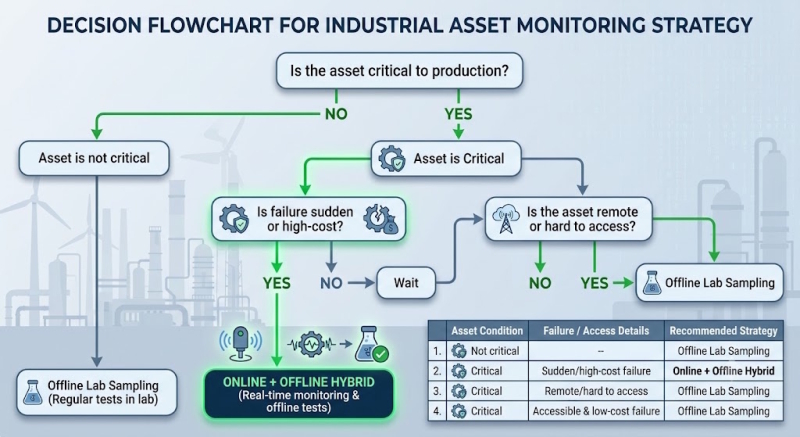
Apply Online Monitoring when:
- The Asset is Production-Critical: Equipment where unscheduled downtime costs thousands of Euros per hour (e.g., main turbine generators, critical extruders, primary gearbox drives).
- Failure Modes Develop Rapidly: Systems prone to sudden water ingress, rapid thermal breakdown, or aggressive particulate contamination where a monthly lab cycle is too slow to prevent catastrophic damage.
- Equipment is Inaccessible or Hazardous: Remote assets like wind turbines, offshore rigs, overhead cranes, or sub-surface pumps where manual sampling poses safety risks or logistics costs.
Rely on Offline Laboratory Analysis when:
- Comprehensive Wear Chemistry is Needed: Detailed elemental wear analysis (ICP) is required to pinpoint exactly which internal component (bearings, gears, thrust washers) is wearing down.
- Monitoring Balance-of-Plant Equipment: Standard pumps, blowers, and secondary hydraulic units where routine monthly, quarterly, or semi-annual sampling provides sufficient lead time.
- Verifying New Oil Deliveries: Confirming baseline quality, additive chemistry, and initial cleanliness of incoming bulk oil drums or tank truck deliveries.

4. The Ideal Strategy: The Hybrid Reliability Model
Rather than viewing online and offline monitoring as competing methods, world-class maintenance facilities integrate them into a hybrid condition monitoring framework:
- Continuous Online Safeguard: Inline sensors monitor moisture (% RH), overall oil condition index, and particle counts on critical assets 24/7.
- Event-Driven Offline Verification: When an online sensor triggers an early-warning alarm threshold (e.g., a sudden jump in particle counts or moisture saturation), technicians immediately take a targeted sample for full laboratory analysis.
- Scheduled Baseline Audits: Routine laboratory analysis is conducted at extended intervals to validate sensor calibration, track elemental wear, and verify overall fluid health.
By combining continuous real-time coverage with deep laboratory diagnostics, plant maintenance teams eliminate blind spots, extend lubricant life, and safeguard critical machinery against unplanned downtime.