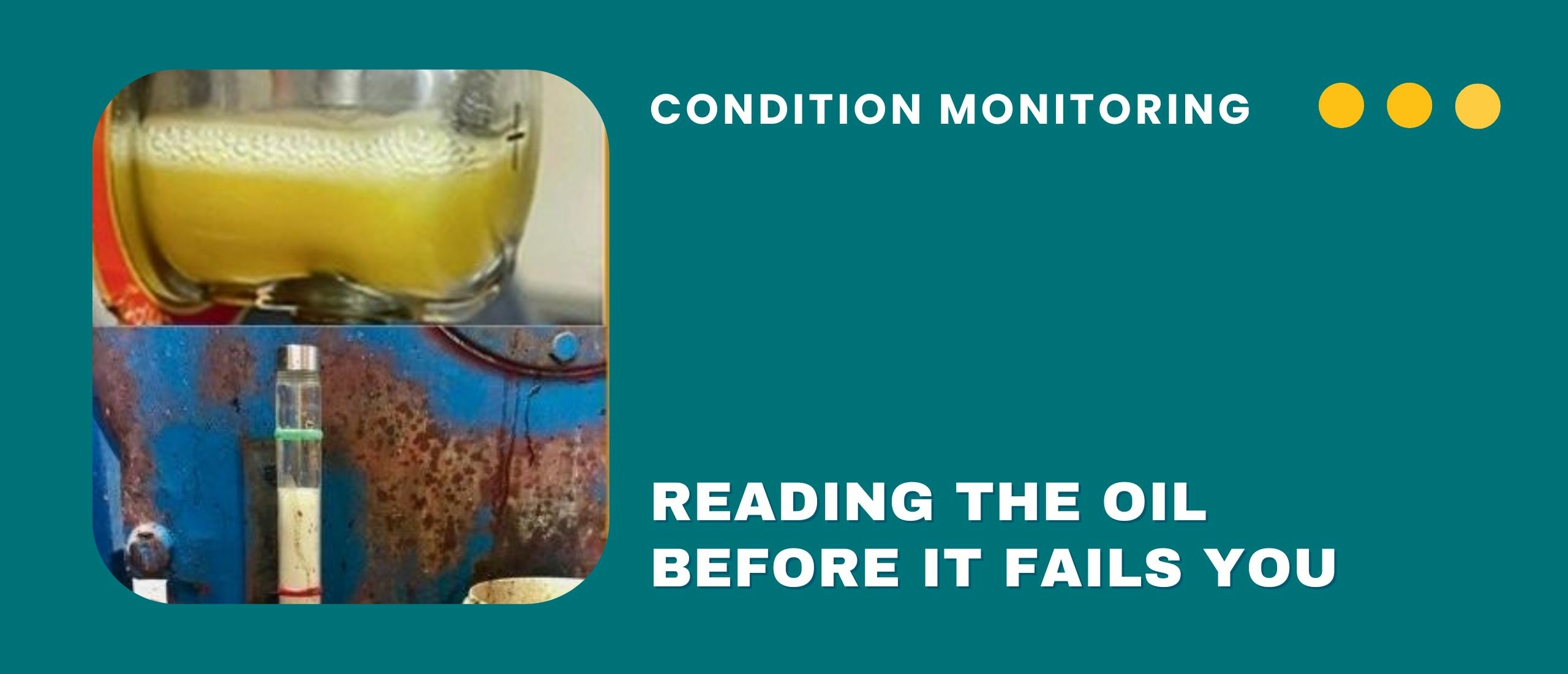
Reading the oil before it fails you
Most maintenance teams find out about a bearing problem the hard way; after it's already cost them a shift, a repair bill, or worse. Yet a huge share of that damage announces itself long before the machine actually seizes. It just does so quietly, in a small glass window most people walk straight past.
That window is the sight glass, and learning to read it properly is one of the cheapest reliability upgrades a plant can make.
Why lubricant condition matters so much
Lubrication failures aren't a minor contributor to breakdowns - they're one of the biggest. Oil isn't just there to reduce friction; it's carrying heat away, keeping contaminants suspended until they can be filtered out, and forming a microscopic film that stops metal surfaces from ever actually touching. When that film breaks down, wear accelerates fast, and by the time vibration analysis or a lab report flags it, the damage is often already under way.
A sight glass gives you something lab sampling can't: immediacy. No waiting for results, no courier, no delay ; just a look, right there on the walkdown.
Four warning signs worth learning
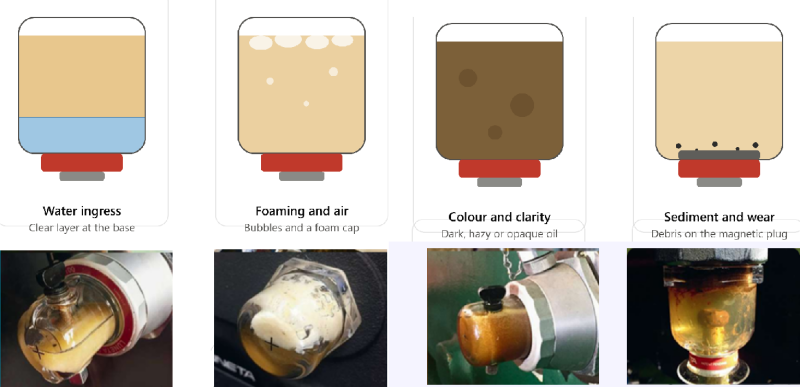
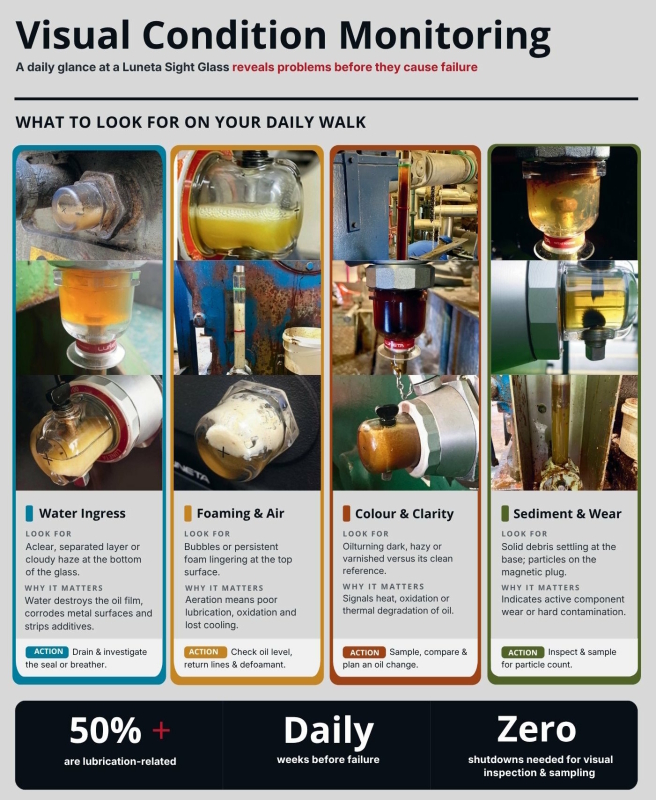
Water. Even a small amount of water in oil is disproportionately harmful. It strips away additive packages, corrodes internal surfaces, and destroys the oil's ability to keep parts separated. On the glass, it shows up as a distinct layer at the bottom, or as a cloudy, milky tint through the whole sample. Either way, it points to a seal problem, condensation, or a breather that's no longer doing its job, and it needs draining and investigating promptly.
Air and foam. Bubbles moving through the fluid, or a stubborn foam cap sitting on top, both mean the oil isn't doing its job properly. Aerated oil lubricates poorly, oxidises faster, and loses much of its ability to carry heat away. This is usually worth checking against oil level, return-line integrity, and whether an anti-foam additive is still active.
Colour change. Oil darkens and clouds over time regardless, but a sudden or dramatic shift, particularly toward a hazy, varnished, or opaque look, usually signals heat stress or oxidation well beyond what's normal. Comparing a sample against a clean reference is the simplest way to judge whether a change is routine ageing or a red flag.
Debris and sediment. Fine metallic particles gathering on a magnetic plug, or visible grit settling at the bottom of the glass, are about as direct a wear signal as you'll get without a lab. It's worth pulling a sample for a formal particle count and taking a proper physical look at the equipment.
The real advantage: no downtime required
What makes this kind of inspection genuinely valuable is that it costs nothing in production time. It's a look, not a shutdown. Built into a normal operator route, it turns every walkdown into a small piece of predictive maintenance — catching problems while they're still cheap to fix, rather than after they've become an unplanned outage.
None of this replaces lab-based oil analysis or vibration monitoring. But as an early-warning layer that costs almost nothing to run, a sight glass check earns its place on every daily route.
Make visual inspection part of every route.
See more. Protect more. Spend less.