
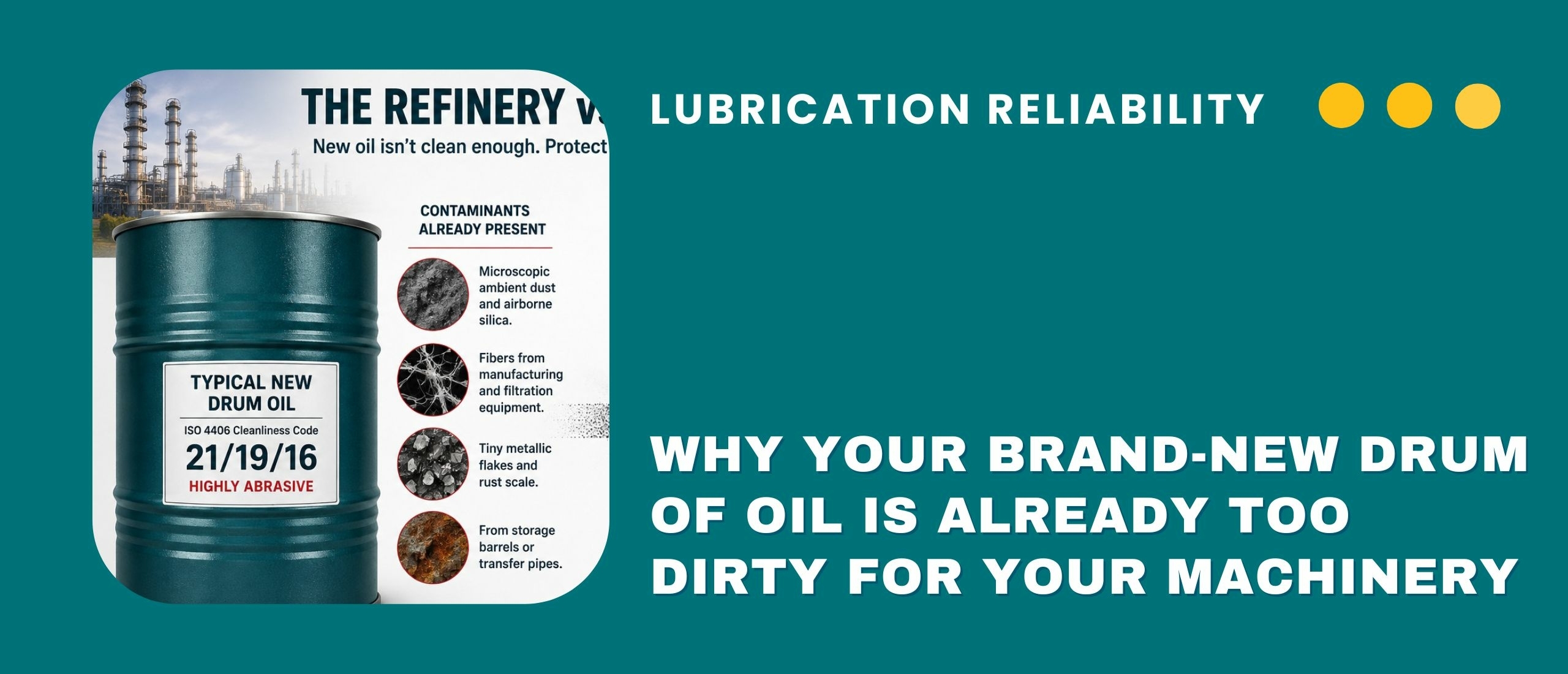
Why your brand-new drum of oil is already too dirty for your machinery
It is one of the most persistent and costly myths in industrial maintenance: "If the oil comes straight out of a brand-new, sealed drum from a reputable supplier, it must be clean."
Believing this myth is actively costing your plant money.
In reality, a brand-new drum of industrial lubricant delivered directly from the refinery often contains 10 to 20 times more particulate contamination than a modern hydraulic system or high-speed bearing can safely tolerate.
Here is why new oil is dirty oil, and how failing to recognize this creates a massive financial leak in your operations.
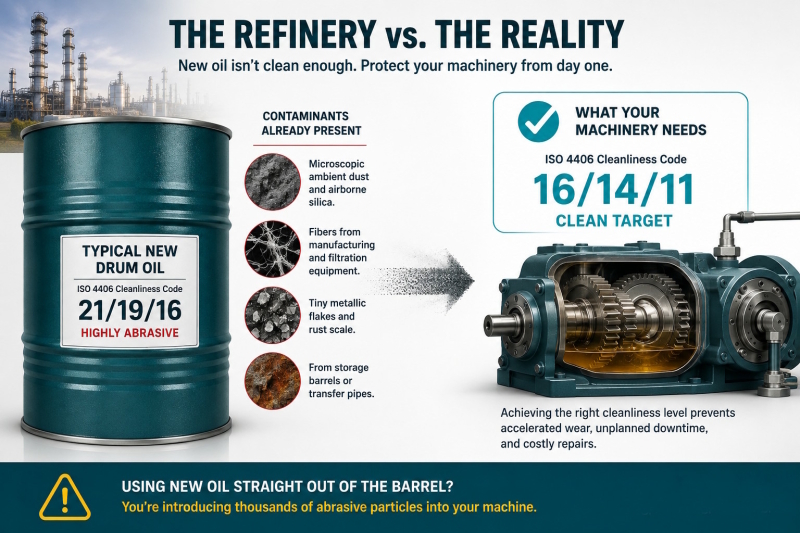
The Refinery vs. The Reality
Oil refineries are built to blend and package lubricants in massive volumes. They are not cleanrooms. During the manufacturing, storage, and packaging process, lubricants travel through extensive piping networks, blending tanks, and temporary holding vessels.
By the time the fluid is pumped into a standard 208-liter steel drum, it has already picked up:
- Microscopic ambient dust and airborne silica.
- Fibers from manufacturing and filtration equipment.
- Tiny metallic flakes and rust scale from the internal walls of the storage barrels or transfer pipes.
When measured against the ISO 4406 Cleanliness Code, a typical new drum of oil often scores around 21/19/16. For context, a sensitive hydraulic system or high-performance gearbox typically requires a cleanliness level of 16/14/11 or better to prevent accelerated wear.
Using that new oil straight out of the barrel means you are actively introducing thousands of abrasive particles into your machine.
The Invisible Killer: What Happens Inside Your Equipment
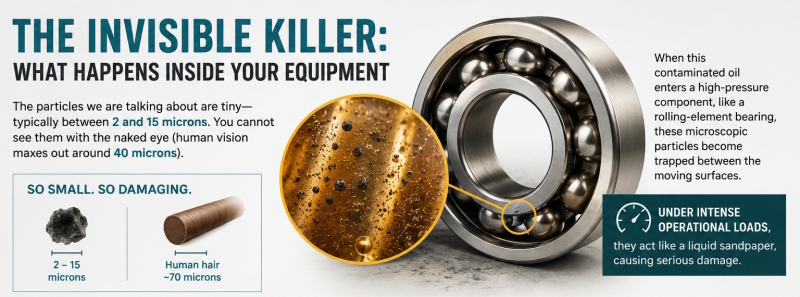
The particles we are talking about are tiny—typically between 2 and 15 microns. You cannot see them with the naked eye (human vision maxes out around 40 microns).
When this contaminated oil enters a high-pressure component, like a rolling-element bearing, these microscopic particles become trapped between the moving surfaces. Under intense operational loads, they act like a liquid sandpaper, causing:
- Abrasive Wear: Scoring and scratching the polished metal surfaces.
- Surface Fatigue: Micro-cracking that leads to severe pitting and eventual catastrophic component failure.
- Shorter Lubricant Life: Particulate matter acts as a catalyst for oil oxidation, degrading your lubricant prematurely and forcing more frequent oil changes.
The Lubrication Reliability™ Solution: Pre-Filtration
To protect your equipment, your maintenance team must treat new oil as a raw material that requires processing before it can be used.
- Never Pour, Always Pump: Never use open funnels or open-top pitchers to transfer oil.
- Filter Every Drop: Implement a strict pre-filtration protocol. Pass the oil through a dedicated offline filtration unit or filter cart before it enters your bulk storage tanks or machine sumps.
- Seal and Breathe: Ensure that all storage containers are equipped with high-efficiency desiccant breathers. Standard mesh caps allow the oil to breathe in ambient factory moisture and dust every time the temperature changes.
Conclusion
Achieving world-class machine reliability doesn't require reinventing your plant. It requires changing your perspective on cleanliness. By shifting from a routine "top-it-off" mindset to a structured contamination control strategy, you protect your machinery, eliminate unexpected downtime, and dramatically lower your yearly maintenance spend.
Want to see how your storage habits stack up?
Don’t guess your lubrication health. Download our free Industrial Lube Room Audit Checklist to instantly identify hidden contamination risks in your facility and start saving your bearings today.